By Tommy H. Thomason
Thursday, January 21, 2010
Be Careful Out There
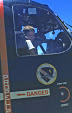
The warning on Yorktown's island was pointedly punctuated in October 1954 by an AD Skyraider propeller blade that broke loose during a crash similar to the one about to occur in the picture above. The blade is just visible between the R and the E of BEWARE.
Sunday, December 20, 2009
It Seemed Like a Good Idea at the Time VII
By 1950, the Navy had determined that overall dark sea blue was too visible under certain conditions for some missions, so it was inclined to adopt a paint scheme that was less so. One under consideration was the Air Force practice of leaving the aircraft unpainted, except for markings and skin panels that were not as corrosion-resistant as those formed from Alclad aluminum. Not painting aircraft had the additional benefit of reducing weight as well as initial and operating cost. Ever cautious, however, and in consideration of the much more corrosive environment that its carrier-based aircraft were subjected to, the Navy embarked on an evaluation program. Beginning in April 1952, the experiment was to involve approximately 100 F9F-5s (including F9F-5Ps and at least one F9F-2), all F7U-3s, 100 F2H-3s (and apparently some F2H-4s) and all FJ-2s. In cases where the external skins were not Alclad, they were painted with an aluminized lacquer that closely resembled the natural metal.
The natural metal F9F-5s and F2Hs were scattered among squadrons that also operated over-all blue airplanes.
The light gray areas on the F7U's aft canopy, lower side of the nose, and rudders are magnesium or other material which required painting for corrosion protection or to match the overall natural metal finish.
Some strangely colored F9F-5s resulted from aft fuselage substitutions to maximize the number of airplanes available for missions.

Although there are reports that a clear coating was used to protect the bare aluminum, it would appear from at least one report that the only protection suggested was a wax that was not readily available. By mid 1953, the results were already becoming apparent: corrosion ranging from slight to severe. Any cost benefit of not painting the aircraft was more than offset by the additional corrosion control effort required. One deployed squadron reported corrosion spots that varied up to 1/8" in diameter and several thousandths of an inch deep. In February 1955, the Navy decided to paint all its tactical airplanes in a gray/white scheme with the experimental airplanes to be painted by July 1955.
For more background on this experiment, see this 1953 issue of Naval Aviation News, pages 13-15.
Saturday, December 12, 2009
It Seemed Like a Good Idea at the Time VI
This was of particular interest to the U.S. Navy because of the need to minimize the approach speed of carrier-based jet airplanes. In 1951 a Navy engineer suggested using the problem as part of the solution, with the jet engine compressor being a convenient source of the air required.A test program resulted a few years later with a modified F9F Panther. At-sea carrier trials in 1954 demonstrated a significant reduction in approach speed, 10 to 15 knots depending on weight, which was limited by inadequate roll control at the lower speed rather than stall.

Although it provided more lift at a given speed or the same lift at a lower speed as a non-blown wing, BLC was a maintenance burden, increased weight and complexity/cost, and robbed the engine of thrust on a wave off and takeoff. Troublesome failure modes included the fire hazard of a leak of the hot air in the ducting and a roll control problem on takeoff or landing if one side or the other failed to provide air for some reason. My guess is the overall experience in the 1960s resulted in BLC being infrequently taken out of the designer's tool box thereafter. The only current application that I can think of offhand is the Japanese ShinMaywa seaplane, which needs to take off and land at extremely low speeds in order to land in relatively high sea states in open water for at-sea rescue. In this case, the BLC air is taken from a compressor driven by a fifth and small turboshaft engine.
Thursday, December 10, 2009
The Reason for Those Lines on the Vertical Fin
A closeup shows that the lines were marked in degrees.
The more subtle angle of attack markings used operationally are just evident on the leading edge of the fin of this F9F Panther.
These markings weren't of use at night, of course. In that case, the LSO relied on an "approach light" in the leading edge of the left wing. There were three colored lenses in front of the light so that he saw green for too slow, red for fast, and amber for on-speed based on the attitude of the aircraft at the proper approach altitude. The light only came on when the hook was lowered so it provided a positive indication that the hook was down at night. (A field carrier-landing switch was provided for practice night approaches ashore.) LSOs also used the relative orientation of the running lights (and on propeller-driven airplanes, the flames from the exhaust stacks) to determine the speed (actually angle of attack) of the approaching airplane.
Within a few years after angle-of-attack measurement and cockpit display were added to Navy carrier-based jets in the early 1950s, the LSO was provided with an angle-of-attack indication via three lights. Again slow (actually, too high an angle of attack) was green, on-speed was yellow, and too fast was red. The lights were generally located in a box mounted on the nose landing gear as shown here.
*I don't know why, but F2H-2 Banshees didn't have these stripes even before angle of attack indication became available. On the FJ-1 and F2H-1, they were placed on the nose - on both sides of the FJ-1, probably because North American didn't know what they were for...
Sunday, November 29, 2009
Air Groups and Markings in Transition
At the time, the standard Navy color scheme was an over-all sea blue; it was about to be changed to a light gull gray over white scheme to reduce visual detection at high altitudes. The Banshee sports an experimental natural metal approach authorized in 1952, which was being tested because it saved weight and the cost of paint and painting the aircraft. It proved to not be cost effective because of the increased corrosion control and remediation effort required.
The composition of the air group was also in transition. Up until the mid-1950s, the air groups were assigned two or three day-fighter squadrons and two or three day-attack squadrons. Each squadron was marked with the air group's assigned tail code, in this case "E". Upon deployment, the air group was augmented with detachments from big "composite" squadrons, which provided the aircraft and training for special missions like night attack, night fighter, heavy attack, nuclear weapons delivery, photo reconaissance, and airborne early warning. Each of these squadrons was assigned a two-letter tail code and up until now, retained them during the deployment. For example, the VC-5 Savage is marked the "NB" of VC-5, not the "E" of Air Group Eight. Air Group Eight had also deployed with AD-4Ws from VC-12 (NE), F2H-2Ps from VC-62 (PL), and HUPs from a helicopter utility squadron, HU-2 (UR). The VC-4 Banshees were assigned the air group for all-weather fighter missions and visual delivery of the Mk 8 nuclear bomb (the big pylon that mounted the bomb is visible just outboard of the engine inlet).
In this case, the VC-4 Banshee is now marked with the air group's tail code, E, although on the original print it's clear that "NA", the VC-4 tail code, is on the tip of the vertical fin. It's also marked with a 6xx series number, which is again an extension of standard air group markings, 1xx denoting the first fighter squadron, etc. This picture is therefore an example of the beginning of the fuller integration of the squadrons with the air group that was being accomplished. All-weather fighter and heavy attack squadrons were to become assigned to the air group rather than being detachments from a parent specialty squadron. (With the introduction of the A-6, all-weather attack also ceased to be a detachment.) All detachment aircraft from the remaining specialty squadrons like airborne early warning (VAW instead of VC after June 1956) and photographic reconnaissance (VFP after June 1956) were eventually to be marked with the air group tail code and three-digit numbers on the nose in accordance with a standard scheme for the duration of a deployment.
In mid 1957, the single-letter air group tail codes were changed to two letters. The first letter was either A for an east-coast air group or N for a west-coast air group. Note that the composite squadron tail codes like NB for VC-5 as on the AJ-2 above did not mean it was a west-coast air group...
Friday, November 27, 2009
A-12, The Gift That Keeps On Giving II
A gift to lawyers, in this case.Back in June, I wrote: "I was surprised when writing the chapter on the A-12 Avenger II program in Strike from the Sea to discover that its termination was still in dispute. Given that it had occurred in January 1991, almost two decades before, that seemed unlikely until I discovered that it involved a $2.3 billion claim by the Navy against GD and Boeing (which now owns McDonnell Douglas, GD's original partner in the ill-fated program). That sum consisted of a demand for the repayment of $1.3 billion in progress payments and $1 billion (and apparently still counting) in interest. Avoidance of the payment of that kind of money justifies the efforts of legions of lawyers.
There were eventually two trials. The contractors won the first in 1995, which the government successfully appealed, and the government won the second in 2001, which the contractors successfully appealed. (A 2002 settlement floundered because the contractors and the government couldn't agree on the value of the "in-kind payments", i.e. goods and services as opposed to cash, to be made by the contractors.) According to today's Wall Street Journal, the U.S. Court of Appeals for the Federal Circuit has finally ruled on the 2007 Claims Court ruling against the contractors, upholding it.
It's probably finally over but I wouldn't bet on it."
And a good thing that I didn't, assuming I could find anyone who would bet against. Here's the latest, from a General Dynamics press release dated 24 November 2009:
The U.S. Court of Appeals for the Federal Circuit today denied a request for a rehearing of the Federal Circuit's prior decision sustaining the government's default termination of the A-12 aircraft contract to which General Dynamics and The Boeing Company were parties with the Navy. General Dynamics disagrees with this most recent decision and continues to believe that the government's default termination was not justified. The company also believes that the ruling provides significant grounds for appeal, and intends to petition the U.S. Supreme Court for review.
Boeing's release was a bit longer:
J. Michael Luttig, Boeing executive vice president and general counsel, today said that the company intends to appeal to the Supreme Court after the U.S. Court of Appeals for the Federal Circuit refused to rehear the company’s appeal in the long-running A-12 case. "We are disappointed in today's decision. The Court of Appeals' decision is clearly wrong as a matter of law and it has broad implications for all forms of government contracting nationwide. As a consequence, I have directed that an immediate appeal be taken to the Supreme Court of the United States," Luttig said. At issue in this litigation, which has been pending over a decade, is the manner in which the Defense Department terminated the A-12 military aircraft program and whether the government owed Boeing (then McDonnell Douglas) and General Dynamics Corporation money for work in progress when the contract was terminated, as well as certain other expenses. The trial court originally ruled in favor of the contractors, but various appeals over the years have delayed a final decision.
As Yogi said, it ain't over 'til it's over.
Wednesday, November 4, 2009
The Hell It Won't Fit
I've read that when the F2H-2B was jacked up to load the Mk 7, metal sleeves were put over the main landing gear pistons to keep the struts fully extended and provide a few inches of ground clearance for taxi and takeoff. This fell off at lift off, restoring normal function to the landing gear struts. That may be but on the F2H-3/4 at least, strut extension was accomplished by a system that added additional hydraulic fluid to the main landing gear shock strut to get a few inches of ground clearance for launch with this huge store. A portion of this fluid was automatically bled from the strut on gear retraction to provide the capability to land with the store, presumably not aboard a carrier. The pilot was provided with a switch to bleed off the remainder for normal strut operation.
This F2H-3 picture shows the extended main landing gear struts. (The weapon is a BOAR, which was a Mk 7 modified with a rocket for greater separation from the explosion, primarily for the benefit of the AD Skyraider community, whose survival after delivering an atomic bomb was otherwise iffy at best.)