U.S. Navy Aircraft History

By Tommy H. Thomason

Tuesday, May 14, 2013

The First Launch of an Unmanned Aircraft from an Aircraft Carrier?

Not the X-47B, despite the press release claim.
U.S. Navy photo courtesy of Northrop Grumman by Alan Radecki

It might not even be the tenth one. For sure there were a few F6F drones catapulted during the Korean War on combat missions:
There were F6F Hellcats launched as target drones.

At least one, anyway:
National Naval Aviation Museum via Rick Morgan

And then there was at least one Regulus missile launch using a cart:
And there may have been some TDN or TDR drone catapult launches although all I've ever seen are deck-run takeoffs of the TDN:

Since the Brits were first with just about everything concerning carrier-based operations, I wouldn't be surprised if they had held the honour on this achievement as well.

But congratulations to Northrop Grumman and the Navy nevertheless. The launch itself is actually not a big deal; F-18 pilots aren't even supposed to have their hand on the control stick during the launch. The taxi forward and hookup to the catapult unmanned? That is a much bigger deal and the X-47B is the first to do that.

The arrested landing on a carrier of an unmanned airplane would also be a first for sure. But not the first hands-off arrested landing. That was done more than 50 years ago. See http://thanlont.blogspot.com/2011/07/look-no-hands.html

The Last Flight of Vought's XF7U-1 Cutlass BuNo 122472

Once again, I've come across something that I would have liked to include in one of my books, in this case the crash report for XF7U-1 BuNo 122472 on 28 September 1949 during takeoff at Vought's temporary flight test facility at Ardmore, Oklahoma.

The first XF7U-1 in January 1949:


When I was writing my history of the F7U-1 (see http://www.amazon.com/Chance-Vought-F7U-1-Cutlass-Fighters/dp/0984611479), I only had a few cryptic statements about the circumstances of the crash, which the pilot, Paul Thayer, survived with only cuts and bruises.

I had assumed that the crash was caused by the load asymmetry (there was a drop tank loaded on the right inboard wing) combined with a new yaw control concept and that it was the first flight in this configuration. I speculated on how that caused the crash. That took some doing because you'd expect a load on the right wing to result in the right wing tip hitting the runway, not the left, if there wasn't enough control power at takeoff speed to keep the heavy wing up.

As it turns out, however, the load was on the right wing and was even greater than in the reports I relied on, a 250-gallon drop tank not 150.  Not only that, this was Thayer's third flight that day in this configuration, which was a big surprise. The only difference on the takeoff this time was a gusty crosswind from the right, not down the runway as before, and he had the canopy open instead of closed. As with the previous two takeoffs, the leading edge slats were closed, which was the preferred configuration for field takeoffs at the time.

Thayer lifted off holding left rudder as I had assumed because of the drag and weight of the drop tank on the right side. (It was even more necessary with a crosswind from the right that I didn't know about.) He then moved the gear handle to the up position, so the gear doors opened and the landing gear began to retract. As the landing gear was coming up, the airplane began to slowly yaw to the left. Thayer pushed right rudder but the left yaw didn't stop and the left wing began to drop. Right stick and more right rudder didn't stop the left roll and yaw so he pulled the throttles off, not wanting to keep trying to fly an airplane that he was not in control of.

The left wingtip touched first just off the left side of the runway, with the airplane slewing around to the left about 100 degrees as it slid across the grass, wheels up, for about 750 feet. During the slide, the forward fuselage broke off just ahead of the engine inlets and wound up lying on its right side at right angles to the fuselage ahead of the left wing.

Vought couldn't find anything wrong with the control system, engines, or anything else for that matter. Although the XF7U was instrumented, it was by means of a photo-observer panel, which means that a picture was taken of a separate set of instruments every five seconds. In other words, the engineers were looking at relatively infrequent snapshots of a rapidly deteriorating situation. Their best guess was that Thayer was too slow and not aggressive enough in his initial response to the left yaw that he had caused with the left rudder required on the takeoff roll. It didn't help that while the landing gear was coming up, there was a significant reduction in directional stability. Or that the wind was gusty.

Their conclusion: "The airplane would be expected to yaw and roll to the left when stalled at high powers with slats closed. The accident, therefore, is explainable on the basis of an early onset of a stall."

Tuesday, April 23, 2013

Things Under Wings: FJ-4B

23 April 2013 Revision: Well, that didn't take long. Gerry Whiteside has correctly identified the weapon on the FJ-4B in this post as a 750-lb Mk 77 Fire Bomb modified with a Mk 19 Bomb Conversion Kit. I've revised the post accordingly...

I'm just knowledgeable enough to know that these are not standard bombs under the wing of  a VA-63 FJ-4B:
Emil Buehler Library, National Museum of Naval Aviation

My go-to guy for stuff like this, Jim Rotramel, confirmed that it was definitely not a 2,000-lb bomb as a caption in at least one publication would have it but did not know what it was.

And there is a second picture of one being jettisoned from a different VA-63 FJ-4B:


Emil Buehler Library, National Museum of Naval Aviation

What was somewhat mystifying at first is that this is a squadron airplane, not a North American dog ship or a VX-5 FJ-4B that would usually be used stores-jettison envelope tests, one of the more dangerous flight test events (the store might depart cleanly or it might go rogue, with dire consequences).

But wait, there's more: the photo caption for the first picture indicates that it was taken on 9 September 1958, shortly after the squadron had begun a deployment aboard Midway (CVA-41). A stores-carry and jettison evaluation by a squadron at sea? That seems unusual even though those were somewhat more permissive times in Naval Aviation.

Close examination of the store suggested that it might be an AJ Savage tip tank with the addition of a tail fin kludge (for one thing, the fins are externally braced).

Note the clear nose and that they might be painted sea blue. The FJ-4B store seemed a bit longer than the AJ tank but that could have been a modification, like the addition of the shackles and fins. (The FJ-1 Fury carried a similar tip tank and an longer version was used to provide the range, just barely, for the Bendix Trophy "Race"  in 1948.)
As a result, I had thought that it might have been a kludge to provide a source of external fuel tanks because not enough of the unique FJ-4 drop tanks were available for this deployment, one of the first for the FJ-4B.

Another guess was that it was a revisit to a home-grown napalm bomb concept to have on hand for crowd control if necessary. That turned out to be close. As Gerry pointed out in his comment below, it is actually a standard 750-lb Mk 77 fire bomb with the Mk 19 bomb conversion kit. It does in fact have a clear nose cone over the igniter. The addition of tail fins in the bomb kit allowed it to be dropped from a dive as opposed to a low-level pass.

Wednesday, April 17, 2013

American Military Transport Aircraft Since 1925


This was a pleasant surprise. I never expected to see an entire book dedicated U.S. military fixed-wing transports. Yet another book on fighters, bombers, or strike airplanes, yes. But transports, even as important as they are to the services? Moreover, it’s clearly a labor of love based on its considerable breadth and depth of content. E.R Johnson is the author; he has written three other well-received books on aviation subjects. The esteemed Lloyd S. Jones did the three-view drawings. Aviation historian David W. Ostrowski provided the majority of the many photographs.

Presumably in order to hold publishing cost down, it’s soft cover and there are no color pictures. That’s pretty much where the frugality stops. Including the index and glossary, there are 480 pages of text, pictures, and drawings. One hallmark of scholarship and quality is the care taken to provide captions under the photographs that add content rather than state the obvious or worse, contain errors. Although the book is generously illustrated, with one or more on almost every page, there is plenty of text including specifications and a three-view provided for each airplane entry.

The book is divided into three main sections: 1925 to 1962, 1962 to present, and utility and miscellaneous transports since 1962. I’ve had a lifelong interest in airplanes and there are several that I haven’t heard of and many that I know little about.

Checking one that I am familiar with did reveal an error. The General Motors TBM-3R entry repeats the usual misstatement that it could carry seven passengers. Strictly speaking, it was a seven-place airplane, with one of the seats occupied by the pilot and another usually reserved for a loadmaster/crew chief. So it was intended to carry five passengers. I also doubt that the bomb bay was used to carry someone on a litter as the text implies; there was no hope of his survival if the airplane had to be ditched or crash landed. Also see http://tailhooktopics.blogspot.com/2013/01/tbm-3r-cod.html.

However, that may well be the only mistake in the book and skimming other entries with which I am familiar, I didn’t notice any more. The interweb is very useful for fact checking and looking up background on aircraft and incidents of interest but the accuracy and completeness vary significantly. I much prefer books like this. McFarland provided it to me for review but I would have bought it anyway.

McFarland's website to order books is www.mcfarlandpub.com; the phone number is 800-253-2187. It’s also available from Amazon and as an ebook (see www.mcfarlandpub.com/customers/ebooks for providers).

Tuesday, March 26, 2013

F4H-1, F4H-1F, F-4A?

This shouldn't be that confusing but I was momentarily discomfited by a poorly worded description of the transition recently so herewith an summary illustrated history.

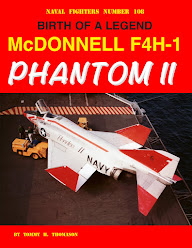
The F4H-1 (F for Fighter, H for McDonnell Aircraft, 4 for the fourth fighter that the Navy was serious about having McDonnell develop) first flew in 1958. It was powered by two J79-GE-2 engines.

Early in the F4H production program, the Navy decided to change to the more powerful J79-GE-8 engine. As a result, the designation of the first 47 F4H-1s that had the early production inlet was changed to F4H-1F in May 1961 when the last one was accepted. (A retroactive redesignation without a configuration change was unusual but not unknown; at least if you give me time, I might think of another one.) The F suffix denoted an engine change. Subsequent production with the -8 engine were still F4H-1s for a short while.

In November 1962 the airplane designations of the Army, Navy, and Air Force were changed to be common and consistent. As a result, the F4H-1F became the F-4A and the F4H-1 became the F-4B, which I have to admit is a more straightforward way of identifying the production configuration change.

The main external difference between the standard production F-4A and F-4B was the engine inlet.*

 In addition to the changes shown in the illustration above, the inlet boundary layer discharge system was modified as well: the major difference was in the shape and size of the exhaust vents on the upper side of the nacelle aft of the inlet. Outlets on the inboard side of the variable ramp were also deleted.

Most of the F-4As were assigned to training squadrons VF-101 (Oceana, Virginia) and VF-121 (Miramar, California).

Five were used in project LANA to compete for the Bendix Trophy in May 1961, celebrating the 50th anniversary of U.S. Naval aviation (L for 50 + ANA for Anniversary of Naval Aviation). It was a cross-country time-trial race from Ontario International Airport, California to NAS New York. The fastest Phantom averaged 870 mph for two hours and 47 minutes. Three subsonic in-flight refuelings were required.


The last F-4A built, BuNo 148275, was retired in April 1968. It has been on display at the U.S. Naval Academy at  Annapolis, Maryland since 1969. It is periodically repainted by the midshipmen in a different squadron's markings.
Robert F. Dorr Collection

*The flush canopy and small radome, which is what most people associate with the early F4H, was only on the first 18 of a total of 47 F4H-1Fs. The remaining 29 had the raised canopy and at least two of the first 18 had the bigger radome. For more on the configurations of the early F4Hs, see http://tailspintopics.blogspot.com/2009/11/early-phantom-iis.html

Sunday, March 24, 2013

A Brief History of F8U Crusader Armament

The Navy originally bought the F8U Crusader as a carrier-based "day fighter". That basically meant that it didn't also need to be capable of finding and shooting down another aircraft in low visibility conditions, e.g. cloud, or at night. It turned out to be the last of the pure gunfighters in the Navy.

For a summary of F-8 (F8U-1/2) Crusader configurations by suffix letter , see http://tailspintopics.blogspot.com/2009/10/f8u-crusader-variations.html

The F8U-1 (F-8A) did have a small radar that the gun sight used for automatic ranging but did not provide visual assistance to the pilot. It was armed with four 20 mm cannon and 2.75-inch rockets.

 The rocket pack tilted down when the rockets were to be fired:

The rockets proved to be not only not effective except as an area suppression weapon due to inaccuracy but also downright dangerous. To maximize the number carried versus the frontal area of the pack, one set of 16 was loaded ahead of another. If a rocket in the forward set did not fire, the one behind it, when fired, might stay in the pack, still burning. Rockets occasionally did not clear the pack, which meant that it could not be retracted and could potentially keep one of the nose gear doors from opening, which meant the nose gear would not extend.
 The combination of useless and hazardous resulted in them being deactivated in the fleet. For a bit more on the rocket pack, see http://thanlont.blogspot.com/2008/12/missed-it-by-that-much-ii.html

For various reasons, the Navy didn't shut off production of F8Us with the rocket pack for a while, resulting in the Controller General telling Congress in July 1964 that the Navy could have eliminated them and saved about $4 million in 1958 (about $31 million now) instead of having Vought build 306 F8Us with that capability.

Far more effective than the rocket pack, at least from an air-to-air standpoint, was the addition of heat-seeking Sidewinder missiles, first two, one on each side of the fuselage:
If two Sidewinders was good, four would be better. This capability was introduced with the F8U-2 (F-8C) but there were a couple of extendable legacy things that had to be avoided, the inflight refueling probe on the left side of the fuselage:
And the ram air turbine (RAT) on the right side:
(Also see http://thanlont.blogspot.com/2009/01/rats.html)

As a result, the two-Sidewinder pylon on the right was not a mirror image of the one on the left and no two missiles were oriented exactly the same:
Note that these illustrations include the wing pylons added with the F8U-2NE (F-8E).

Visual-assist radar was added to the F8U beginning with the F8U-1E (F-8B). However, it wasn't going to be much of an all-weather fighter if it wasn't armed with an all-weather missile. A radar-guided Sidewinder, the AIM-9C, was developed, qualified, and deployed. It was, however, subsequently withdrawn reportedly because its envelope was too restricted and it wasn't very reliable. (I don't know why the Sparrow III capability was never incorporated.)

The AIM-9C is on the upper rail and the 9D on the lower.
 U.S. Navy via Gary Verver

Since a carrier air group can only carry so many airplanes, general-purpose fighters that had a strike capability were preferred to one-trick ponies like a day fighter. As a result, wing pylons with a stores capability of 2,000 lbs were introduced with the F8U-2NE (F-8E) and retrofitted to the F-8Cs and F-8Ds that were remanufactured to be F-8Ks and F-8Hs respectively:
Note that although qualification of the Bullpup on the F8U began, it wasn't completed and no squadron deployed with the capability. For a bit more on that, see http://thanlont.blogspot.com/2008/10/general-purpose-f8u.html

It was apparently intended that the pylons also be used to carry external fuel tanks. Vought flight tested them but for some reason that capability was also never used in the fleet as far as I know.
For one thing, the F8U already had great endurance for a jet and for another, the likelihood of the tank hitting the horizontal stabilizer may have been off-putting. (If this was a concern, it was overcome during Vought A-7 development.)

However, the F8U was qualified to carry bombs on the pylons and two-shot Zuni rocket pods on the two-station Sidewinder pylons, four Zunis to a side.
Although carrier-based F8U squadrons fired Zunis and dropped bombs, primarily on air defense suppression missions, the shore-based Marine squadrons probably employed it in the ground-attack role to a greater degree, dropping whatever was at hand:

Wednesday, February 27, 2013

Your Speed May Vary

Once upon a time, the U.S. Navy and Air Force vied with each other and the military services of foreign countries to set aircraft performance records in speed and altitude. Attempts at surpassing the existing records did not always reflect operational capability although the record-setting aircraft usually bore a much closer resemblance to their counterparts on the flight line than say, some of the air racers at Reno to their original configuration.

For example, in the days before jets had enough power to exceed the speed of sound in level flight and the attempt had to be made at an altitude just above the ground, the venue for the record attempt was increasingly someplace hot. The limit on speed had become the abrupt change in drag with Mach number. Mach number varied with air temperature. Higher temperatures meant a higher Mach number and therefore the airplane could achieve a higher speed over the ground.

However, the record aircraft were almost never stock. Engines vary more than you might think in terms of horsepower and thrust even before being tweaked for more. Engine and other limits were routinely exceeded at the expense of durability and safety. Removal of nonessential stuff, e.g. military equipment, to reduce drag and weight was a standard practice. (If guns and ammunition were carried, the fact was always worthy of note in the press release announcing the record.)

I was recently reminded of a couple of examples of somewhat more extensive modifications. The thrust provided by the J79 engines in the F4H-1 that then LtCol Robert Robinson (USMC) used to set a speed record of 1,606 mph in December 1961 was augmented by water injection.

 Robert F. Dorr Collection
If you look closely at the aft cockpit of the record setting airplane, you'll see what appears to be the water tank.
Note also the non-standard reinforcement of the windscreen. According to Robbie, the windscreen over-temperature light was on for most of the speed run, warning of imminent failure.

Needless to say, Phantoms in the fleet were not capable of anywhere near 1,600 mph.

Even more extensive modifications were made to a Navy HSS-2 in pursuit of a helicopter speed record. In February 1962, it was used to set a record of 210 mph versus a fleet Sea King's top speed of not much more than 150 mph.
 The most significant modification was the replacement of the landing gear with skids. It was also lightened as much as possible and tape and filler applied to reduce drag. For more on that project, see http://www.thisdayinaviation.com/5-february-1962/

Unofficial speed records were even more likely to approach bogus. One example is the well- publicized report that the XF4U-1 had demonstrated a speed of 400 mph. For a discussion of the unlikelihood of that, at least in late 1940, see http://thanlont.blogspot.com/2008/10/400-mph.html.

Sometimes the false claim was at least somewhat inadvertent. On 17 June 1980 during envelope expansion with a full load of research instrumentation and no particular attention paid to drag reduction, the Bell XV-15 tiltrotor research aircraft achieved a measured true air speed in level flight of 301 knots as first calculated by engineering.

Much celebration ensured and a press release immediately issued by marketing. As it turned out, the initial calculation failed to take into account the correction required on the outside air temperature measurement, understandably because it is negligible at the speeds that helicopters normally achieve. When recomputed correctly, the actual speed was a few knots less than 300. Bell management chose not to update the number since it had already been promulgated worldwide. In any event, the milestone did not have the expected impact because 301 knots—while roughly twice that of a helicopter not tricked out like the HSS-2—was half that achievable by a jet-powered VTOL like the Harrier. Not until the XV-15 flew at the Paris Air Show in 1981 and it was subsequently flown by guest pilots did the operational benefit of the tiltrotor concept become apparent to prospective customers.