By Tommy H. Thomason

Tuesday, July 24, 2012

Tailhook? We don't need no stinking tailhook...


When an aircraft carrier deploys, it departs with an air wing comprised of several specialized squadrons to provide a full offensive and defensive capability.  The exact composition of the air wing has varied over the years, but in addition to fighter and attack squadrons, there are always airborne early warning and reconnaissance airplanes as well plane guard/utility helicopters. Now electronic warfare airplanes are a standard part of the air wing.

Fighter and attack squadrons were typically assigned to a specific air wing for an extended period of time. At one point, in the late 1950s and early 1960s there were usually three fighter squadrons per air wing even though only two were required for a deployment. Because of the rapid development of new or improved fighter types at the time, one of the three was likely to be in transition to a new type and not ready to deploy.

For various reasons, a squadron might not be ready for deployment with its air wing and a substitute was required. Often, this would be a Marine Corps squadron since its pilots would all be naval aviators, qualified for carrier takeoffs and landings. VMFA-333 deployed several times, for example flying F-4s with Carrier Air Wing Eight aboard Nimitz in 1976.
 Official U.S. Navy photo via Johan A. (Hans) Engels (see http://www.thunderstreaks.com/)

One very non-traditional Marine Corps squadron deployment took place on the last cruise of Roosevelt. VMA-231, flying AV-8A Harriers, was assigned to Carrier Air Wing 19 for its cruise in the Mediterranean from October 1976 to April 1977. Also aboard were two squadrons of F-4Ns and three of A-7Bs, along with detachments of E-1Bs (for the last deployment of this type), RF-8Gs, and SH-3Gs.

In the mid 1970s, the Navy was seriously evaluating a transition to V/STOL aircraft for all sea-based, manned, tactical air missions instead of building more big aircraft carriers equipped with catapults and arresting gear. In early 1976, the CNO briefed OSD on a tentative plan to do so.  The assignment of VMA-231 to the Roosevelt’s air wing was intended to provide insight into the feasibility and benefits of a operating a V/STOL fighter/bomber at sea.

The Harrier had been in service with the Marine Corps since 1971 and had already been evaluated in an extended series of at-sea trials aboard, among others, the amphibious assault ship Guam (LPH-9) that was serving as an Interim Sea Control Ship. This resulted in the development of a corrosion control plan for an extended deployment among other operational procedures. However, there were still concerns about the Harrier’s maintenance requirements, hot exhaust, lack of endurance, etc.

VMA-231 worked up to the deployment via a series of mini-cruises aboard Franklin D. Roosevelt beginning in late June 1976. These established operating procedures and familiarized the ship’s company with the unique characteristics of the Harrier, like the downward-directed engine exhaust in VTOL mode.

 U.S. Naval Institute Proceedings October 1977

V/STOL advocates considered the experiment a virtually unqualified success. Complying with standard carrier cyclic operations (90-minute flight period for the conventional takeoff and landing airplanes) proved to be unnecessary since the Harriers could land in any open space during a launch/land cycle. Benefits demonstrated early on included no time or crew required to hook up to the catapult for takeoff, virtually no waveoffs (and zero bolters), and the ability to back into a designated parking space. The Harriers could also land with the ship steaming out of the wind in conditions that precluded the operation of its conventional airplanes.

Rolling takeoffs were a bit more problematical in some wind over deck conditions but a vertical takeoff was almost always possible. Flight time, however, was limited to 20 minutes by the reduction in fuel required.

Over 2,000 sorties and landings, 15% at night, were accomplished by VMA-231 during the deployment. There were no aircrew or aircraft losses, a non-trivial accomplishment given the accident rate of carrier operations. The promise of V/STOL seemed to have been clearly demonstrated and V/STOL aircraft welcome aboard.

In parallel with and supported by this evaluation, the Navy initiated a set of V/STOL development programs, with V/STOL A being a subsonic multi-mission aircraft and V/STOL B, a supersonic fighter and attack aircraft. (There was also a V/STOL C, which was to be a smaller ASW aircraft to replace the LAMPS Mk III helicopter operating from frigates and destroyers.)

Except for Bell's tiltrotor and Sikorsky's ABC, the V/STOL A concepts used various forms of lift fans and/or high-bypass-ratio jet engines like this Vought proposal.
The V/STOL B designs were equally innovative, in some cases using lift fans for more efficient vertical lift like this McDonnell Douglas concept.

After only a couple of years of studies, however, the Navy reversed course after completing its Sea-Based Air Master Study in 1980. It concluded that an all-V/STOL approach incorporating existing technology was high risk and in any event would cost more than utilizing conventional airplanes.

Two aircraft, the V-22 Osprey and the F-35B, did eventually result from the Navy's flirtation with V/STOL, however. The tiltrotor had been proposed for V/STOL A and thereby attracted the attention of the Marine Corps. The F-35B resulted from follow-on research programs to advance V/STOL technology. It's therefore possible that the U.S. Navy might yet transition to V/STOL carriers...

Monday, June 18, 2012

A Designation Story Redux

In A Designation Story (http://thanlont.blogspot.com/2011/10/designation-story.html), I discussed why the WF-2 was a -2 and not a -1.

In it, I mentioned the TF-1, which was the Carrier On-board Delivery (COD) derivative of the ASW S2F as the WF-2 was the AEW derivative of the S2F. I also wrote about the TF-1 in my summary history of COD, http://thanlont.blogspot.com/2011/05/carrier-onboard-delivery.html


All these years, it had never occurred to me that the T in TF didn't make sense for a COD. At the time, T was the mission designation for trainer. The Navy mission designation for transport was R (I don't know why) or JR, if it was a utility transport (I don't know what the difference is between a utility transport and a regular transport is either). So strictly speaking, as a transport it should have been designated RF or a JR3F (there was a JRF and a JR2F). In the 1962 DoD-driven redesignation of Navy airplanes, it was rightfully given a C for Cargo designation, C-1.

It turns out that for some reason, the Navy decided that it would be designated a trainer. And of the five missions listed on the TF-1 SAC, three are training, including the first two:
Of course, it would have been a lot cheaper to build S2Fs without the mission equipment and designate them S2F-1Ts. It would have (and eventually did when the early S2Fs were replaced with more capable S2Fs) been capable of all those missions, albeit with less volume for cargo/passengers and a cabin door smaller than a car's. It wouldn't, however, have been capable of resupplying a carrier with a nuclear weapon the size of the Mk7, which if I remember correctly, was the actual raison d'etre of the TF...

Sunday, June 10, 2012

An Unusual SB2C

This post is the result of a question posed to me by Angelo Romano, which was both surprising and pleasing. Normally it's me asking Angelo for something and I appreciated the chance to return the favor.

The request was to identify the unit to which this SB2C-4E was assigned. The picture was reportedly taken after the war, possibly at NAS Atlantic City in 1947.
Warren Bodie photo, Thomas Doll collection via Angelo Romano 
 
Via Steve Eisenman
 
It has been published in various places and the aircraft (or one numbered 47) has even been the subject on decal sheets for modelers, with the assigned unit either identified as VS-31 or stated to be unknown.

The camouflage and markings are unusual. First, it is one of the two so-called Atlantic schemes for ASW aircraft commonly seen on TBF/Ms, SBDs, and FMs but almost never on an SB2C. Second, there is that "XVF" marking on the side, where a unit designation would sometimes be at the time.

The unit to which it was formerly assigned was almost certainly VS-31, with the S at that time standing for Scouting, not ASW. (ASW squadrons then were typically designated VC for composite, meaning they operated more than one mission type of aircraft.) VS-31 was an inshore patrol squadron and did not deploy on an aircraft carrier. According to author Marc Frattasio, "VS-31 flew SB2C-4Es from NAS Squantum from the end of 1944 through May 28th 1945. During that time the squadron operated detachments at NAS Atlantic City, NAS Norfolk, and possibly other locations. Previously, the squadron had operated a detachment at NAS Brunswick. To the best of my knowledge VS-31 was the only unit to operate SB2Cs in the Atlantic ASW color scheme." (Marc literally wrote the book on NAS Squantum: see http://www.gis.net/~fm/squantum.htm)

That, however, does not explain the XVF marking. It turns out that on 15 June 1945, the "Navy established Experimental Development Squadron Two Hundred (XVF-200) and Experimental Utility Squadron Twenty Five (XVJ-25) at Naval Air Station Brunswick, Maine, to provide, under the direct operational control of Commander-In-Chief (COMINCH), flight facilities for evaluating and testing tactics, procedure, and equipment for use in special defence tasks particularly those concerned with defence against the Kamikaze."

XVF-200 was assigned F6F-5s and F4U-4s. One might wonder why no Goodyear F2G Corsairs were assigned, since it was purportedly developed specifically to counter the Kamikaze. As it happened, the F2G program began before the Kamikaze tactic became evident in late 1944 so that wasn't its raison d'etre, at least originally. (My tongue-in-cheek explanation is that someone in BuAer wondered how fast a Corsair would go when powered by the humongous P&W R-4360.) And only a handful had been built and flown at the time, whereas the fleet needed to deal with the threat with what they could had or could get right away.
 From the collection of Joe Genne via Rob Mears

XVJ-25 was assigned a smorgasbord of airplane types to provide transport, target towing, targets, etc. From the 7 September 1945 USN Aircraft Location Report:
(Rockland was NAAF Rockland, Maine. At the moment, I don't know what a WF6-3 is; it's apparently not a typo because there were about 450 in the replacement pool on Guam...)

It would appear that at least a few of the SB2C-4Es were transferred to XVJ-25 from VS-31 when that unit was disestablished.

At some point in late 1945, certainly by 25 January 1946, the date of the USN Aircraft Location Report that Angelo provided to me,  XVF-200 was relocated to NALF Fentress, Virginia and XVJ-25, to NAS Atlantic City

Sometime before the date of that report, possibly as a result of that relocation, XVF-200 had also been assigned 12 SB2C-4Es in addition to those being operated by XVJ-25. It is likely that one of these, a former VS-31 airplane, is the one in the picture.

According to Angelo, who has better and more organized files than I do,  XVF-200 was subsequently disestablished on 15 March 1946 so strictly speaking, if the picture was taken in 1947, it wasn't at the time assigned to XVF-200. (The snow also suggests Maine in late 1945 or January 1946 although it's not unknown in New Jersey.) XVJ-25 was redesignated VJ-20 on 7 March 1946 and and eight days later, became VX-2. That caused me to correct my blog post on VX squadrons (http://thanlont.blogspot.com/2010/07/vx-squadrons.html).

Tuesday, June 5, 2012

Midway

A doomed VT-8 crew taking off on a one-way mission to attack the Japanese carriers off Midway on 4 June 1942.

Once upon a time, a friend loaned me a computer game that replicated, in some detail, the battle of Midway. I played it several times, me controlling the U.S. forces and the computer, the Japanese. Even knowing the initial disposition of the Japanese forces, which the U.S. Navy had to determine by scouting, I got my butt kicked every time. The superior range of their scouts and strike airplanes was one of the deciding factors. And yet the Americans prevailed in the battle, arguably the turning point of the Pacific war. I put it down to mostly luck but there was more to it than that. Here is an excellent synopsis of some of the other factors if you don't have time to read a book like Shattered Sword..

Thursday, May 31, 2012

Loading the Sting

They got to see the world but there was hard work along the way when your job was arming the airplanes:

Here, deckhands are loading a torpedo on a T4M-1 aboard Saratoga (CV-3) in May 1929.
National Archives 80G-21692

This is a 1,000-lb bomb being slung under a Marines Corps BG-1 dive bomber in February 1937.
National Archives 80G-216907

Being part mountain goat didn't hurt at times, particularly when the job was loading ammunition in the folded wings of a Grumman FM-1 Wildcat aboard Mission Bay (CVE-59) in January 1944.
 National Archives 80G-229237

But it wasn't all rough duty. Sometimes it was bombing up a Martin PM-1 seaplane at Pearl Harbor, Hawaii in October 1933...
National Archives 80G-216911

National Archives 80G-216914

Tuesday, May 29, 2012

Neptunus Lex is back


Carroll LeFon, aka Neptunus Lex, died two months ago trying to land a Kfir in below-minimum weather conditions at the only airfield he could reach with the fuel remaining. (Preliminary Accident Report) Among other things he left behind was one of the wittiest and thoughtful blogs on the interweb in my opinion. It has been off line for a few weeks but thanks to the efforts of one of his daughters, it is now back: http://www.neptunuslex.com/

Sunday, May 27, 2012

Navy Joint Fighter Conference - October 1944

The Navy's Bureau of Aeronautics sponsored a Joint Fighter Conference that was held at NAS Patuxent River, Maryland on October 16-23, 1944. Representatives were invited from the Army, Navy, Marine Corps, Royal Air Force, Royal Navy, and Royal Canadian Air Force as well as from NACA and the manufacturers of engines/equipment and fighter aircraft like Grumman.

A large fleet of fighters was assembled for the pilots to evaluate:
General Motors FM-2
Grumman F6F-5, F6F-5N, F7F-1, XF8F-1
Vought F4U-1C, F4U-1D, XF4U-4
Goodyear FG-1*, FG-1A, XF2G-1
Lockheed P-38J, P-38L-5
Republic P-47D, P-47M
North American P-51D
Bell YP-59A, P-63
Northrop P-61
North American P-51D-5
Fairey Firefly Mk 4
Supermarine Seafire L2C, Seafire 3
DeHavilland Mosquito
Mitsubishi "Zeke 52"
*Bubble Canopy

More than one of some types was available on the line.

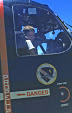
The manufacturers were eager to participate and put their best foot forward. Some of the airplanes were still in flight test or fresh off the production line. Here, an evaluation pilot poses in one such F4U. (The cut line in the Navy photo names him as Royal Navy Lt. J.P.M. Reid but as Bing Chandler points out in his comment below, facial hair rules this out; I agree that he resembles Commander Paul Ramsey.)

In addition, a Hoover Horizon in an NH (a single-engine, high wing, instrument trainer built by the Howard Aircraft Company) was available for flights. It combined the directional gyro and artificial horizon on one instrument along with a depiction of clouds above the horizon and trees below. Anti-G suits were provided for flights in airplanes with that capability. The F6F-5 was equipped with a lead-computing sight and an SNJ was assigned to be the target.

Each pilot (there were about 60 in all including Charles Lindberg) listed the airplanes that he wanted to fly and whether in daylight or at night. Daily flight schedules were prepared accordingly. What the pilot did during his flight was entirely up to him. The only obligation was to get the airplane back on time and fill out a two-page post-flight questionnaire based on what was looked at.

The only caution with respect to the operating area was to not bounce any airplanes in the Armament Test range south of the Patuxent River since "If pilots should jump an airplane there they might not be seen by the people operating turrets and the possibility exists of running into some complication along that line." 

For purposes of identification for this evaluation, each airplane was marked with a number on the mid fuselage behind or below the cockpit  beginning with an FM-2 that was 1. (The large number on some cowls in the photo above was the last three digits of the Bureau Number, often applied when an airplane wasn't assigned to an operational squadron.) The call sign was simply "Blue" and the evaluation number.

Here, Commander Paul H. Ramsey, Director of Test at NAS Patuxent River and chairman of the conference is climbing into Blue 24, a P-47 (the M according to the photo caption but a D according to the serial number). Note the gloves in hand, dress shoes, knee board strapped to thigh, and ear phones around the neck in lieu of a helmet. The life vest was recommended because there was a lot of water in the area.

Checkout, even by the standards of the day, could only be described as perfunctory. At the opening session, each contractor was given three to four minutes to describe their aircraft's "special qualities and restrictions, and general information relative to their use, speed, etc." Knee-board cards were provided that listed general data, the engine limits, and in some cases, airspeed limits and other cautions/restrictions. Each airplane was assigned a check-out pilot who stood on the wing and provided advice and counsel to the evaluation pilot until he had started the engine.

Here, McDonnell test pilot Woodward Burke is being given a checkout in the Zeke by Lt. C.C. Andrews, NATC project officer, Tactical Test, on the left with C.L. Sharp, a Chance Vought test pilot, on the left wing.

Report of Joint Fighter Conference: NAS Patuxent River, MD 16-23 Oct. 1944 was published by Shiffer Military History in 1998, with technical editing by Francis H. Dean. It is a compilation of documents and transcripts from the conference. It includes a memo to the BuAer Chief summarizing the results, the transcribed (including errors) remarks of the daily briefings and wide-ranging discussions, a summary of the opinions (qualitative and quantitative) for each type, etc. The Report is a fascinating time capsule of the status of U.S. fighter airplane capability, issues, and development as of October 1944. My favorite is the statement by a test pilot from Hamilton Standard who was answering a question about counter-rotating props: "Commander, after just flying the (YP-59A), I am out of business and I don't think there is any reason why we should talk about dual rotation. If anybody needs a good tug boat captain or something, that is about all I can talk about. I just finished the test in the squirt job and I have about two pages of comments. First I am going to hand in my resignation."

5 September 2016: Ted Dettman created a summary of the rankings (1 is best) from the data in the book:
The F4U comes out best overall based on this, but in action the P-51 was obviously good enough where it mattered, e.g. range, which isn't a figure of merit that was evaluated at this conference. The Navy considered buying a carrier-based variant of the P-51 late in the war (http://tailspintopics.blogspot.com/2011/06/seahorse.html) but by that time, jet fighters were clearly the future so they bought what was arguably a jet-powered P-51 from North American instead.

A possibly apocryphal (but definitely plausible) anecdote that might explain two Navy airplanes being in the top three was that early on in the production of the F4U and the F6F, the Navy gave Grumman an F4U to evaluate and Vought, an F6F, suggesting more of the better airplane would be bought and maybe the one they were building wasn't it. Certainly the Navy had a practice of contracting for the development of two different airplanes for the same fighter mission, thereby incentivizing its contractors to do their best.