By Tommy H. Thomason

Monday, September 22, 2008

Development of the Davis Barrier


The Davis barrier was created by the Naval Aircraft Factory to replace the conventional barrier that was satisfactory for stopping single-engine propeller-driven airplanes that didn't pick up an arresting cable with the tail hook but not for twin-engine ones like the F7F Tigercat. The problem was that unlike the single-engine situation, where the propeller hit the barrier cable at a very shallow angle and wouldn't cut it, the nose gear of a twin-engine airplane would pull the cable out and forward, so when the propellers got to it, the cable might be at enough of an angle for it to be cut.

This wasn't exactly the situation here, but demonstrated the problem. In this test, the Davis barrier used a one-inch steel cable to actuate the retarding cable that was to snag the main landing gear. Fortunately the PBJ (U.S. Army Air Forces B-25) was unoccupied for the test, because a prop cut the actuating cable and flailed the cockpit with it. This resulted in the actuating cable becoming a canvas strap.

Friday, September 19, 2008

What's That?


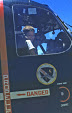
It turns out to be an extendable radome housing an H2X radar. The TBM was a control plane for a TDN/TDR drone equipped with a transponder and a TV camera. In 1943. The controller in the TBM could guide the drone to the target using the radar and then dive it into the target using the TV image. Neither the drone nor the target needed to be within eyesight of the control plane.

Although it worked, the Navy fighting the war in the Pacific would have nothing to do with it. At the insistence of the Navy in Washington, the Special Unit involved was finally allowed a 30-day trial in late 1944 against Japanese targets on and near Bougainville and Rabaul that arguably demonstrated the effectiveness of the concept. It was then summarily withdrawn and disbanded. (It's not clear whether the beyond-visual range capability was utilized.)

For a good summary of the TDR (the very similar TDN wasn't used in combat), see http://evanflys.com/tdr-1

The photo is National Archives 80-G-387191.

TDR three-view and operational photo:


Tuesday, September 16, 2008

Is This The Grumman F12F?

In a word, No. The F12F designation was assigned to a derivative of the F11F Tiger that was to be powered by the new General Electric J79 engine. It's not clear if a contract was ever issued but two Bureau Numbers were assigned. The program was canceled in January 1956.  The effort to evaluate the F11F with the J79 continued, however. The first of two F11F-1Fs flew in May 1956.

Pictured is the Grumman Design 118 proposed to the Navy in late 1955. It and a single J75-powered alternative were rejected in mid-1956 in favor of the Vought XF8U-3. It is unlikely that the Navy ever considered it seriously enough to assign it a designation since the McDonnell F4H was already on contract. Somebody subsequently and erroneously concluded, because of the concurrency of the projects, that it was the D 118 that received the F12F designation. Someone else has speculated that it would have received the popular name "Lion". Officially it never did and I've seen no evidence that Grumman referred to it internally as that.

Note that since enthusiasts continue to insist that it was the F12F,  I've updated this post with more information on the actual F12F program here:  http://thanlont.blogspot.com/2018/02/one-more-time-grumman-f12f.html

Saturday, September 6, 2008

Bell XFL-1

I have this weakness for unappreciated "failures" (see Bell HSL and Grumman/GD F-111B below). My latest attempt to provide a nuanced and balanced account of a little known or notorious aircraft program is the one-off Bell XFL-1, a navalized version of the much more successful but frequently maligned P-39 Airacobra.

Saturday, August 23, 2008

Single-Seat A-6


The Navy's VA(L) was to be a single-seat, single-engine attack airplane with an overload mission of 12 Mk 82 (500-lb) Snakeye bombs delivered at a radius of 600 nautical miles. Another key requirement was that it be "a modification of an airplane currently in the Navy inventory." The payload/range favored the use of the Navy's new TF30 engine.

Grumman considered proposing either a TF30-powered F11F or a single-seat modification of its A-6 Intruder with a single seat but the existing engines. The latter's size enabled it to easily exceed the payload/range requirement even though it did not have the fuel-efficient turbofan engine. (Although the A-6's size was a drawback from the spot factor standpoint, it could be mitigated by folding the horizontal tail; see http://thanlont.blogspot.com/2009/06/minimizing-spot-factor.html.) Grumman decided to offer the A-6 derivative believing that the low development cost and commonality with an existing airplane in the air group would trump the somewhat higher unit cost.

It didn't.

Douglas proposed a supersized version of its A4D.

North American did the same with its FJ-4.

Vought won the VA(L) competition with an F8U Crusader derivative with an even more creative interpretation of the "modification" requirement than Douglas or North American proposed.

For a last minute change in the Vought proposal, see http://thanlont.blogspot.com/2009/06/it-takes-all-running-you-can-do-to-stay.html

Sunday, August 17, 2008

Attack Crusader

Vought went all out for the 1963 VA(L) competition. The Navy wanted six main stores stations. Vought decided to propose eight, plus the pylon on each side of the fuselage for Sidewinders. The Navy thought that eight was more than enough, too many in fact. Otherwise, Vought's proposal was exactly what the Navy wanted and superior overall to the ones from Douglas, Grumman, and North America.

Thanks to the Vought Aircraft Heritage Foundation for the photo.

Saturday, August 2, 2008

Little known (and unsuccessful) Proposals

In May 1949, Martin submitted a proposal to BuAer for a two-seat, twin-engine, carrier-based jet attack airplane with the Martin rotary bomb bay.

My guess is that it was an attempt to take advantage of the A2D troubles at the time. Douglas got a letter of intent for the T40 turboprop-engine-powered A2D in June 1947. It was supposed to fly in March 1949. Because of T40 engine problems, it didn't fly until May 1950.

Thanks to the Glenn L. Martin Maryland Aviation Museum for the illustration.