By Tommy H. Thomason

Monday, April 20, 2009

If You Can Read This...

Ramp strikes occur when a pilot gets too low on an approach to the carrier and hits the round-down at the aft end of the deck. Many end very badly unless it is just a hook slap. Rare now, they occurred more frequently before the advent of the angled deck as pilots were concerned about landing long on an axial deck and crashing into the barriers that protected the people and airplanes forward. The landing signal officer will call "power" if the approaching airplane begins to sink below the proper glide path.


Several years ago, I spent a day and a night as a guest aboard the carrier Eisenhower off Norfolk while it was being used for carrier qualifications by F-18 Hornet pilots. Day landings were straight forward, with few bolters, fewer waveoffs, and an occasional desultory call by the Landing Signal Officer for "power". Night landings were entirely different. Frequent waveoffs and bolters, and often the call for "Power, Power!, POWER!!" After one of these, the LSO went so far as to call the pilot on his downwind and say, "When I say Power, you add Power. Don't second-guess me. Do it again and I'm sending you to the beach."

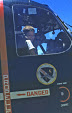
If you click on the picture*, you should be able to read the warning on the ramp...

*USN 090415-N-7241L-239 by Specialist second class Nathan Laird

Sunday, April 12, 2009

Almost 50 years Ago!

On 1 November 1960, give or take a day or two, Forrestal was being borrowed by NATC for additional carrier trials of new aircraft about to be delivered to the fleet: the Vought F8U-2, the North American A3J-1, and the McDonnell F4H-1. They have been positioned for a launch event on a gray day in the Atlantic. Each will be started and taxied back for launch from the starboard bow catapult. This route involves both turning out of and into the strong wind over deck that might be needed for launch, a check of braking and steering capability.

The requisite bridles/pendants to attach the airplanes to the catapult and holdback pendants to restrain them until the catapult has begun to stroke are piled along the starboard side of the deck. These predate the nose gear-mounted hardware that will be introduced with the next generation of carrier-based airplanes to simplify the process.

I believe that the photo was taken by Pete Bulban, an Aviation Week writer for many years. In any event, it was in his collection that was obtained by Jay Miller.

Monday, April 6, 2009

All-Weather Skyhawk

To provide a modicum of all-weather capability to the Skyhawk, Douglas added a small radar to the nose of the A4D-2N. This was to provide terrain clearance during a descent in instrument conditions to 1,000 feet above ground level, where the pilot was hopefully in visual flight conditions. (A simple autopilot was also added to reduce pilot workload when he was on instruments.) The attack still had to made visually as the radar provided no means for targeting. According to the service acceptance trials report, "It must be recognized that the capability is marginal and requires highly trained pilots thoroughly qualified in radar navigation techniques."

Note the anti-flash hood behind the pilots head that he would pull over the cockpit during the bugout after delivery of a nuclear weapon to reduce the risk of injury and damage from the thermal effects of the nuke's detonation.

Saturday, April 4, 2009

Say Hello to My Little Friends

Between the Korean and Vietnam wars, one of the primary missions of the U.S. Navy attack carriers was the destruction of Chinese and Soviet military bases with nuclear weapons if the cold war became hot. In order to increase the number of nukes that could be delivered in the first wave, the A3D Skywarrior fleet was to be augmented by a squadron or two of diminutive A4D Skyhawks.

The Skyhawk was point designed to be as small as possible, so more could be accommodated on each carrier. One fallout of its minimum size and weight was the absence of a radar that would enable more accurate navigation at night or in poor visibility conditions.

A tactic to reduce the likelihood that the Skyhawk pilots would get lost en route was to have them fly on the wing of an A3D, which was not only equipped with radar but carried a crewman trained in the art of celestial navigation. The A3D crew would lead them to a visible landmark, at which point the A4D pilots would break off and all would continue independently to their assigned targets.

The capability was futher enhanced by the addition of aerial refueling equipment to the A3D as a tanker and the A4D as a receiver, thereby extending the Skyhawk's range. Nevertheless, its pilots still referred to their mission as one man, one bomb, one way.

Thursday, March 26, 2009

Once Upon a Time

This is Saratoga (CV-3) in the early 1930s with a partial deckload of Boeing fighters, Curtiss or Vought scout bombers, and Martin torpedo bombers. All are biplanes; only the last have folding wings. There are approximately the same number of airplanes on deck as there are in the Hornet picture, with plenty of room left for more. In fact, more than twice as many.

Built on battle cruiser hulls, Sara and her sister ship, Lexington (CV-2), were as big and as fast as battleships, the aircraft firepower augmented by eight 8-inch guns in turrets forward and aft of the island and gigantic exhaust funnel structure. They were slightly bigger and faster than the Essex-class carriers that were built just before and during World War II.

Monday, March 23, 2009

An Air Group in Transition

This is Hornet deployed in the Pacific sometime between January and July 1957. The spot configuration appears to be after the last recovery before underway replenishment. All the aircraft, except for the plane guard HUP, are parked to starboard of the foul line denoting the clearance limit for landing aircraft. There are 41 aircraft packed over there, roughly 1/2 to 2/3 of the air group depending on squadron strength. The rest are parked on the hangar deck, which can accommodate a maximum of approximately 40 aircraft depending on the type. (Note that three F9F-8s can be spotted in roughly the same space as two FJs.)

Since these Essex-class carriers only had bow catapults, at least the port column of jets will have to be pulled aft for launches, although the ADs could make deck runs off the angle given appropriate weight and wind.

The deployed air group, CVG-14, consists of two fighter squadrons, one with FJ-3 Furies and the other with F9F-8 Cougars; two attack squadrons, one with AD Skyraiders and the other with F9F-8Bs; and several detachments for airborne early warning (AD-5W), night/all-weather attack (AD-5N), photo reconnaissance (F9F-8P), aerial refueling (the AJs), and utility/plane guard (HUPS) .The F9F-8Bs are place holders for the new light attack jets just finishing development, the A4D Skyhawk and the FJ-4B Fury. The big AJs are at the very end of their useful life, having won a reprieve in the Pacific fleet because of their usefulness as airborne tankers for the jets. They are about to be replaced in their strike role with A3D Skywarriors, the first of which have just been deployed to the Mediterranean.

For some reason, there is no all-weather fighter squadron aboard. This air group had deployed in 1954 with a squadron of F2H-3 Banshees but would then make two successive deployments with no night fighters before VF-141 accompanied it with their F4D Skyrays.

The photo is from the National Archives, 80-G-1023566.

Friday, March 20, 2009

An F4U Corsair?


It's actually an AU-1, a close-air support variant of the F4U-5 developed specifically for the Marines Corps since AD Skyraiders were in short supply. It featured additional armor around the engine and accessories, a single-stage supercharger since only low altitude operation was required, and additional stores pylons. This is BuNo 129325 at Patuxent River in September 1952 making a field arrested landing. (AU-1s had been in combat in Korea since June.) However, the AU probably never flew operationally from an aircraft carrier, much less deployed.

 
In April 1954, 25 of the 111 built were transferred directly from a Marine Corps squadron to the French AƩronautique Navale to augment its fleet of F4U-7s in Indochina. After the fall of Dien Bien Phu and the withdrawal of French forces, the surviving Corsairs were ferried to NAS Sangley Point in the Philippine Islands and parked until a French carrier was available to transport them back to France. Another five were reportedly transferred to the French in the mid-1950s.
 The Marines swapped out AUs for ADs as soon as they could. However, at least a few survived as station hacks through the late 1950s as evidenced by a photo of a gray/white AU assigned to Quantico taxiing out past an early F8U-1, probably at NAS Los Alamitos, CA. (Note that the 'Navy" marking applied in overhaul has been painted over.) These were used to provide ground-based Marine Forward Air Controllers with airplanes to control for close air support training.