By Tommy H. Thomason

Tuesday, October 25, 2011

Douglas F6D Missileer

One of the Navy's ongoing concerns is defense of its ships from attacks by aircraft and/or missiles. The Chinese anti-ship missile threat is only the latest. In the 1950s, it was long-range, high-performance missiles launched from Soviet bombers. The first solution was the Sparrow air-to-air missile carried by fighters whose development had begun in the late 1940s. The F4H Phantom was the first Navy fighter specifically designed for the mission and was also armed with the Sparrow. However, the Navy continued to fret about a combination of faster bombers and longer range air-to-surface missiles that the Phantom/Sparrow approach was not capable of adequately addressing.

The solution from operational analyses was the Missileer concept. The Operational Requirement was issued on 11 July 1955. The "fighter" would simply be a subsonic platform that loitered out on a station on the threat axis,  lugging a huge, long-range radar and up to eight very long-range air-to-air  missiles. The missile's range requirement necessitated that it be provided with its own radar for terminal guidance. That and fuel required range that it was a very big missile indeed. It was to be called Eagle.

Work on the missile and engine design definition began first, because they would take much more time to develop and qualify than the airframe. The Bendix Corporation was selected as the prime contractor for the Eagle, including the airborne radar and missile control system, in December 1958. Grumman (airframe and flight test), Westinghouse (aircraft radar), Litton (tactical computer), Sanders (missile active pulse doppler seeker), and Aerojet (propulsion) were subcontractors.

 The missile with its booster was 16-feet long. Together, they weighed 1,288 lbs, including the missile's on-board radar and 110-lb warhead. The maximum range from launch to intercept was 100 nautical miles against a bomber flying at 60,000 feet and Mach 2.

The Pratt & Whitney TF30 engine was one of the first turbofan-type engines, desired for its benefit on endurance. It was based on an engine that Pratt was developing for airlines.

The invitation to bid on the aircraft wasn't requested until 11 December 1959. Bids were received at the end of February from Chance Vought, Douglas, Grumman, McDonnell, and North America. Douglas was selected. The decision was announced on 21 July 1960.

The Navy's press release was explicit about the F6D's role: "The EAGLE-MISSILEER weapon system employs the concept of building long range and high performance into the missile, rather than into the launching aircraft." The 50,000-lb takeoff-gross-weight airplane was to be capable of operating from Essex-class carriers and loiter on station for four hours at 35,000 feet.


The bulbous nose was necessary to accommodate the Westinghouse AN/APQ-81 radar dish, which was five feet in diameter. (Big as the radar was, the missile's maximum range could only be utilized with the Bendix home-on-jam option.) The two-man crew sat side-by-side, surrounded by avionics. The normal missile load was six, all carried under the wings. Two additional missiles could be carried under the fuselage, increasing the takeoff gross weight by 4,800 lbs.

Unfortunately, the incoming Secretary of Defense, Robert McNamara, decided that it would be cost effective to combine two nascent "fighter" programs, the Navy's carrier-based, subsonic, 35,000-ft loiter Missileer and the Air Force's land-based, supersonic, tree-top ingress, nuclear-strike TFX. Strictly speaking, neither was a fighter and what's worse, two more different tactical airplane requirements would be difficult to imagine. The F6D program was formally terminated in April 1961 (it had been on hold since December 1960 awaiting the Kennedy administration's DoD programs review); Hughes took over the development of the radar/missile program, which was appropriately renamed Phoenix.

The F-111 train wreck, particularly given the Navy's outrage at being subservient to Air Force program management and subsequent passive-aggressive cooperation, was inevitable. For more on the F-111B program history, buy my F-111B monograph HERE.

Saturday, October 15, 2011

A Designation Story

9 June 2024: Adding some detail about the AD-5W

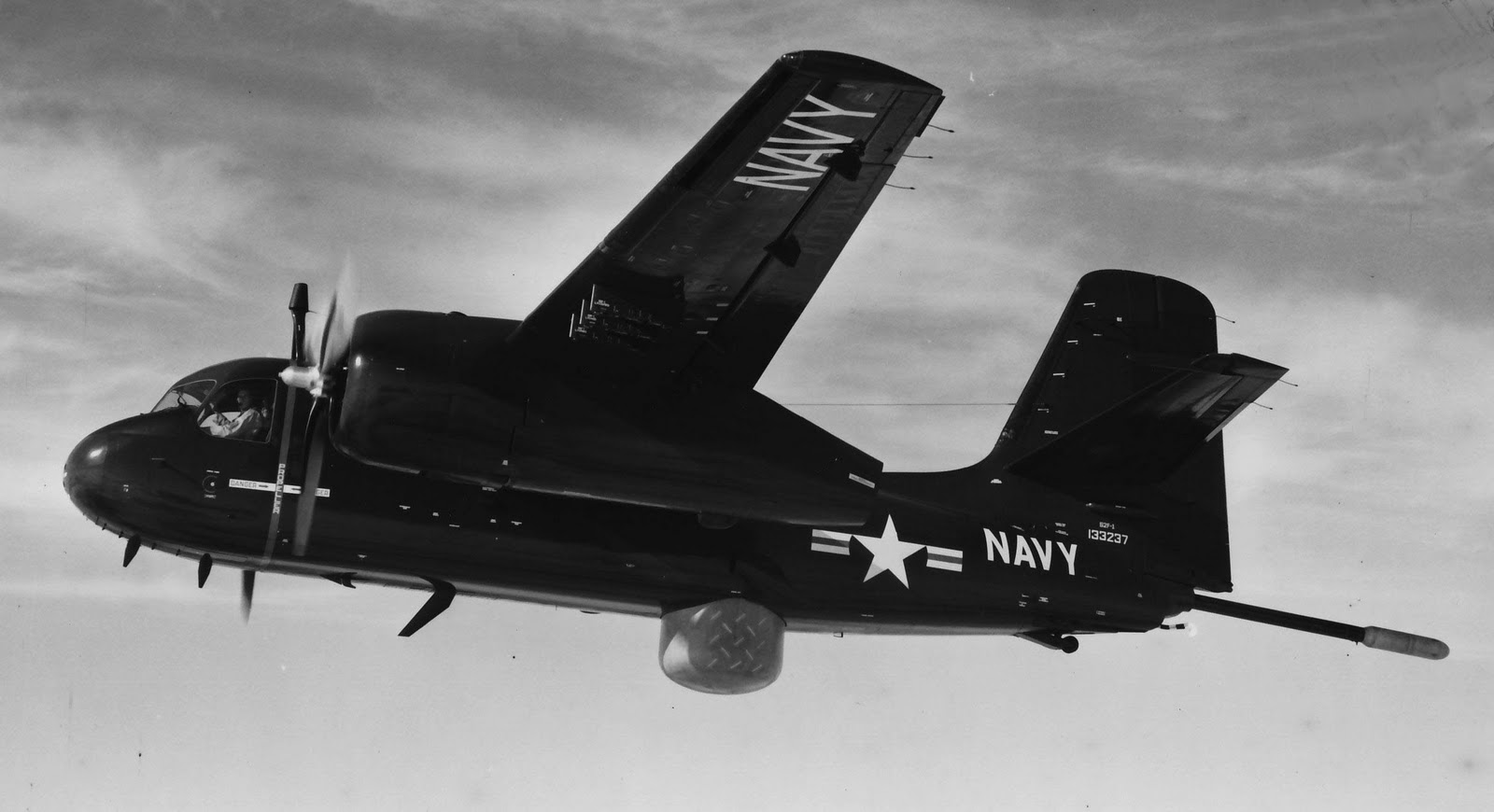
The Grumman WF-2 (E-1B) is an interesting example of the Navy designation system and a little known false start for an iconic Navy airplane, the "Stoof with a roof". For starters, what was the WF-1? And why is there no E-1A?

The basic designation was W for Airborne Early Warning (AEW) and F for Grumman. Up until then, W was a suffix, not a prime mission designation, as in TBM-3W. It indicated that an existing airplane type, the third modification (3) of the first Torpedo Bomber (TB) to be built by Eastern Aircraft (M), had been modified for the AEW mission (W) by substituting a large radar and its cover for the bomb bay. (The 3 actually reflected that it was the third modification of the TBF, since the airplane was originally designed, developed, and produced by Grumman as its first torpedo bomber, with Eastern Aircraft, a division of General Motors, taking over its production from Grumman.)

The TBF-3W was followed by a series of AD Skyraiders, like the AD-3W shown here, modified similarly to carry the APS-20 radar aloft.

As an aside, the similarly configured Grumman AF-2W was used for AntiSubmarine Warfare (ASW), not AEW, with the radar being used to detect a surfaced submarine or more likely, its snorkel. It was paired as a hunter with the AF-2S, the killer half of an ASW team, which was equipped and armed to localize and sink the submarine.

Grumman was in the process of replacing the AF-2W and AF-2S with the S2F, a twin-engine airplane that combined the mission equipment and armament of those two airplanes into one. The S for ASW was now a prefix as W would be for AEW.

The S2F's small radar that was housed in a retractable "dustbin" dome under the aft fuselage was optimized for surface surveillance, not AEW. Grumman therefore proposed a minimally modified S2F airframe for the AEW role, with the APS-20 radar and dome mounted above the cockpit rather than under the fuselage, which would have required a much longer landing gear and therefore required a folding vertical fin/rudder to meet the hangar-height limitation. The forward location of the radome meant that the existing S2F wing-fold system that overlapped the fuselage could be retained. The only change required to the airframe therefore was a slightly deeper fuselage with an aft cabin door and the addition of finlets to the horizontal stabilizer to compensate for the sail area forward that was added by the radar dome.

The Navy ordered two prototypes as the WF-1 in 1952 and assigned them BuNos 133043 and 133044. Grumman accomplished wind tunnel tests and a fuselage mockup before WF-1 development was terminated, probably due to budget priorities (the Korean War didn't end until an armistice went into effect in July 1953 and the Navy needed a swept-wing fighter as quickly as possible) and the availability of the AD-5W.

The AD-5 had first flown on 17 August 1951. An AEW version was ordered as a logical follow-on to the AD-4W and a placeholder for a new twin-engine airplane that was to result from the 1951 competition that resulted in the WF-1. It began to be assigned to squadrons in 1953. Douglas delivered 239 in all. The last two were retired in 1966 from VAW-33 as EA-1Es.

Vought also got an initial contract for WU-1 development and two Bureau Numbers were assigned, 133780/1, but it was cancelled as well. (Note the wing-fold arrangement used to accommodate a radar dome mounted over its mid fuselage.)


Eventually, however, the Navy felt the need to use a bigger, better radar for the AEW mission. The existence of and commonality with the TF-1 Carrier on Board Delivery (COD) variant of the S2F, which had been proposed at the same time as the WF-1, was no doubt one of the deciding factors in the decision to award the program to Grumman. Based on its similarity to the WF-1, the Navy elected to designate it the WF-2 rather than WF-2.

Incidentally, the COD version of the S2F was designated as T for Trainer rather that something like S2F-1R like the TBM-3R because the majority of the missions it was originally intended to be used for were training. See https://thanlont.blogspot.com/2011/05/carrier-onboard-delivery.html

The WF-2 had enough of a family resemblance to the S2F and TF that resulted in it being referred to as the "Stoof with a Roof". The radar was now mounted over the airplane's center of gravity like the Vought's WU-1, which required the substitution of an H-tail and a reversion to the sto-wing fold system that was a Grumman invention. The capacious TF-1 fuselage was lengthened ahead of the wing, probably for center of gravity considerations. Because of uncertainty about the aerodynamic implications of the huge radome, TF BuNo 136792 was modified, except for the fuselage extension and sto-wing, for initial flight test with the radome. (Note the feathered engine.)

In the following picture, the aerodynamic prototype is flying in formation with a production WF-2. Note the different location of the propeller strip versus the pilot's side window, which indicates where the forward fuselage was extended forward.


The sto-wing necessitated the use of a free-swiveling tail wheel because of the aft shift in the center of gravity when the wings were folded.

I can't confirm that the prototype was designated the XTF-1W as Wikipedia currently states. It doesn't seem likely and Larry Webster confirmed that its history card only states TF-1 and C-1A. A very early (but not dated) Grumman S2F brochure describes the AEW and the COD versions as the WF-1and TF-1 respectively. I've also read that the aerodynamic prototype was designated WF-1, with the production airplane therefore being the WF-2. That's definitely bogus.

However, for a short time the WU-1 was referred to, at least by Vought, as the S2U-1W...

After Grumman flight test of the aerodynamic prototype, the radome was removed, and it was assigned to NATC for equipment tests. Eventually a TF/C-1 interior  was installed and the aircraft utilized as a transport by NAS Quonset Point, RI.


According to Angelo Romano, there were three other topless Tracers that were used for pilot training since field carrier landings and real carrier landings, not to mention catapult launches, were hard on the electronics, not to mention that the radar and guys in back were unnecessary for that requirement.

When Navy aircraft designations were changed in 1962 to be consistent with the Air Force system, the WF-2 became the E-1B. Although it could have been argued that there was no need to reflect a universe in which the WF-1 had not been cancelled, the group in charge of redesignation chose to do so.

For a multi-part history of U.S. Navy AEW by a naval aviator, Steeljaw Scribe, who has forgotten more about the subject than I will ever know, see:
http://steeljawscribe.com/2010/10/06/project-cadillac-the-beginning-of-aew-in-the-us-navy
http://steeljawscribe.com/2010/10/09/project-cadillac-the-beginning-of-aew-in-the-us-navy-part-ii
http://steeljawscribe.com/2010/10/17/project-cadillac-the-beginning-of-aew-in-the-us-navy-part-iii

Wednesday, October 5, 2011

Attack on the Broadsword

Captain Carballo and noted Argentinian artist and illustrator Carlos A. Garcia provided more material and Carballo's copilot's name for my post on the one disappointing reproduction in Scooter!. For the update, go to http://thanlont.blogspot.com/2011/09/scooter.html

Tuesday, September 13, 2011

Halcyon Days - 1950

National Archives 80-G-419777


Patuxent River Naval Air Test Center (NATC), September 1950 Static Display

Clockwise from the facing airplane on the left-hand side of the ramp:

McDonnell F2H-2N Banshee (note the elongated nose)

Grumman F9F-2 Panther being flown by Electronic Test

North American AJ-1 Savage

Pratt & Whitney-operated, civil-registered JB-17G (Ron Lewis: See http://www.nationalmuseum.af.mil/factsheets/factsheet.asp?id=2455) with an XT34 turboprop engine in the nose (the T34 was a Navy program but no production resulted for Navy airplanes)

Martin P4M Mercator (Almost certainly BuNo 122208; per Ron Lewis, see http://www.vpnavy.com/vp21_aircraft.html for other pictures of this airplane)

Douglas XF3D-1 Skyknight*

McDonnell F2H-2 Banshee

Vought F7U-1 Cutlass

Grumman F9F-2 BuNo 122563 with photo registration marks

Vought F4U-5P Corsair

Does anyone have any other information about these specific airplanes (particularly the Panther with the X on the fuselage) or the event?

* I had identified the Skyknight as an XF3D because of the small tail bumper (the production airplanes had a bigger one that incorporated a small wheel). Sharp-eyed viewer Ron Lewis noted that and also that part of the BuNo was visible, a 4 and a vertical line that could be part of a 1. Digging further, I'm all but certain that this is XF3D-1 BuNo 121457 that had just arrived at Pax for evaluation of control system modifications accomplished by Douglas.
Picture from Roger Besecker

Wednesday, September 7, 2011

Self Boarding for the Douglas Skyhawk

Up until the early 1950s, self-boarding was a requirement for U.S. Navy carrier aircraft. Boarding ladders were unwelcome on a windy, crowded carrier deck. (Similarly, you didn't see pilots walking to and from their airplanes wearing parachutes: the consequences of a parachute accidentally opening were too serious. As a result, the parachutes were left in the cockpit and the pilot strapped it on or connected it to a torso harness once he was seated.)

With the advent of the large jets that set nose high like the F3H Demon and F7U Cutlass, however, self-boarding provisions began to require mountaineering skills. See HERE and HERE for the two different approaches McDonnell used on the F3H Demon, for example. These proved to be inadequate, particularly on a wet, windy flight deck.

The Douglas A4D Skyhawk appears to have been the first exception to the self-boarding requirement, justified by Ed Heinemann's focus on weight reduction and the degree of difficulty involved in providing a self-contained boarding capability for it. The bespoke ladder was equipped with a tube that inserted into a hole in the left side of the fuselage. Wheels on the bottom of the side frames of the ladder minimized the loads on the mounting structure.

Boarding ladders were subsequently provided for the F3H and F7U although the self-boarding "feature" was retained. The XF4D self-boarding capability was removed for production and a ladder similar to the A4D's provided by Douglas for it. However, there were few exceptions made to the requirement— or provision of boarding ladders as GSE—after these aircraft were retired. (The North American A3J/A-5 Vigilante was one.)

Since a ladder was not always available, particularly for an urgent dismount, some Skyhawk pilots occasionally used the inflight refueling probe installation on the right side of the fuselage to exit the cockpit and move aft around the inlet to the wing and then jump off the trailing edge.
The more surefooted and athletic would go forward and execute a high bar dismount. (In the midst of the Forrestal fire, with his A-4's ladder having been removed, John McCain simply got out onto his probe, went forward on it, and jumped off.) Former gymnastics reportedly even gained access to the cockpit by muscling up on the probe.

With the introduction of the A4D-5 and the strakes forward and below the engine inlets, the degree of difficulty of self-boarding was somewhat reduced and became more common, particularly if malcontent sailors had tossed all the boarding ladders overboard as happened on at least one deployment. It helped if you were flexible and had long legs (but not too long because of the size of the Skyhawk's cockpit) like young T.J. (Jeff) Brown pictured here.

Douglas provided a self-boarding capability for the Blue Angel A-4s that consisted of a very narrow folding ladder stowed in a tube extending from the 20mm gun port in the left wing root.

The two-seat TA-4s had a ladder with a stepped platform that provided access to both the front and rear cockpits.

The TA-4s used for training were much more likely to fly into airfields that didn't have appropriate ladders for ingress and egress. As a result, some squadrons formally condoned and marginally improved the use of the strakes and the cover over the IFR pipe by treating them with a skid-resistant coating on them, as well as on the aft end of the external tanks and a wing walkway as shown here in a picture provided by Rick Burgess:

The front seater used one of the fins on the right external tank to get up on the wing and then went forward around the inlet to the strake and thence along the refueling boom. The guy in the back seat could enter and exit from either side using the strake.

A video of this egress is on Youtube: HERE

Sunday, September 4, 2011

Scooter!

As I said, I'm very pleased with the publication quality of my history of the A-4 Skyhawk, Scooter!, which should be shipping from Amazon, among others, in a couple of weeks. One small disappointment, however, was the reproduction of the picture of Capt Pablo Carballo and Lt Carlos Rinke's attack on Broadsword on 25 May 1982. It wasn't a very high resolution picture to begin with and this regrettably resulted in it being too small in the book to provide the impression that I wanted to convey. Here it is as big as I can make it (click on it for a larger size) and annotated as well:

Both Carballo and Rinke survived the attack (as did Broadsword), reportedly because the Sea Wolf missile system could not choose between their A-4s in the short time that they could be engaged.

Noted Argentinian aviation and maritime artist and illustrator Carlos A. Garcia created the following painting of the action, The Volcanos, based on this picture and interviews with Capt Carballo:
More of Senor Garcia's work can be seen at his website, http://www.aviationart.com.ar/Carlos_Adrian_Garcia_eng/Welcome.html.

Thursday, July 28, 2011

Halcyon Days

Click Here for 23 minutes of footage taken aboard CV-59 Forrestal during its shakedown with ATG-181 in February/March 1956, courtesy of the video library of the San Diego Air and Space Museum.

The Air Task Group, tail code I, consisted of:

VF-41 Black Aces F2H-3 1XX
VF-21 Mach Busters FJ-3 2XX
VA-86 Sidewinders F7U-3M 3XX
VA-42 Green Pawns AD-6 4XX

Detachments were:
VAH-6 (NH) Det 42 Go-Devils AJ-2 XX
VC-12 (NE) Det 42*          AD-5W 7XX
VC-33 (SS) Det 42 Night Hawks AD-5N 8XX
VC-62 (PL) Det 42 Fighting Photos F2H-2P 9XX
HU-2 (UR) Det 42 Fleet Angels HUP-2 XX

*Possibly not in any of the footage

There are a number of transitions to be seen. For one thing, some aircraft are blue and others in the same squadron are grey/white. (The F7Us are still in the experimental "unpainted" scheme.) Click Here for some background on the color scheme change that was decreed a year earlier.

One of the grey/white AD Skyraiders has a black-painted area where the exhaust stains would have otherwise been evident. This was typical of gray/white USAF A-1s in the Vietnam War but I'd not noticed it before on a Navy AD.

Another transition example is that the pilots are still using the flat approach to a cut as directed by the LSO, not the descending approach using the mirror landing system. In one segment, an F2H is on short final with another close behind.
Too close, perhaps, because the LSO can subsequently be seen waving off the second Banshee.

All but one of the FJ-3 landings are with the canopies closed as would subsequently be the practice.
The F2H and F7U pilots all have their canopies open for landing. Although open canopies for carrier takeoffs and landings had been standard since canopies were introduced, this became pilot's choice on straight-deck carriers at some point following the addition of the barricade (click Here for a description of the barriers and the barricade) after an incident or two when the upper strap of the barricade went into the cockpit of a crashing jet. Note that the FJ-3s are taking off with open canopies.

Why are the F7Us in an attack squadron, particularly since they are supposedly the Sparrow-missile armed Ms? The answer is probably that the Navy was transitioning to jet attack and had F7U-3Ms excess to their fighter requirements. Note that in the F7U wave-offs (both of which appear to be from too high a start) and the bolter, the Cutlass hooks are not down. This was a familiarization process building up to the first trap: the approach was the important part of the maneuver and more could be fit into a flight period if there were no traps in between.

The deck runs made the launch a lot quicker but were only practical with propeller-driven airplanes. (The white stripes at an angle to the dashed stripe led to the bow catapults.)

However, it appears that the A3D and A4D were qualified with JATO to allow them to make deck runs if the catapults were down the nuclear strike was called for. An F4D pilot also made a successful deck run, off a British carrier, after he unknowingly lost his catapult holdback capability upon launch from Saratoga to land aboard Ark Royal. Click Here


The F2H-3/4 Banshees had a nose gear that extended for launch. This (and the steam catapult) mostly made up for the fact that they were heavier than the F2H-2 but had the same wing and engines. Note the difference between the attitude of this Banshee about to be launched and the ones in the picture above.

The FJ-3s were started and taxied forward to the bow catapults with the FOD screen in place.

Lots of other details of carrier operation can also be seen, like the little three-wheel self-powered start carts as well as a contrast between the personnel cranials and float coats used today versus their absence then. The use of catapult straps and a separate holdback as described Here instead of todays nose launch arrangement is also noteworthy.