http://www.latimes.com/business/la-fi-navy-jet-suit-20140125,0,4137919.story#axzz2ryLV5DCe
For my previous posts on the tortuous path of the settlement through the courts and negotiations:
http://thanlont.blogspot.com/2013/06/the-12-avenger-ii-program-end-is-near.html
For a Naval Aviation News article on the A-12 Avenger when it still had a bright future, albeit for only a matter of weeks, see:
http://www.history.navy.mil/nan/backissues/1990s/1990/nd90.pdf
This is an illustration from that article:
More Ordnance! Farther! And Stealthy!
Unfortunately, the Navy lost credibility with the Secretary of Defense with respect to the program's cost and schedule and the airplane's weight and capability, which resulted in its cancellation in early January 1991.*
Instead of this great leap forward in carrier-based strike, the Navy eventually decided to buy the F-18E/F and a player to be named later, UCLASS (Unmanned Carrier Launched Airborne Surveillance and Strike).
*For a very detailed account of the A-12 program's rise and fall, see The $5 Billion Misunderstanding by James P. Stevenson. For a much shorter and more readable one, buy my book, Strike from the Sea (see the sidebar).
By Tommy H. Thomason
Friday, January 31, 2014
Monday, January 13, 2014
Finding the Way Home
Anybody can find their way nowadays with GPS, even back to a carrier far at sea, never having caught sight of land. It took considerably more skill in World War II, although the naval aviator was provided with electronic tools to do so.
For more on each of these tools, see http://tailspintopics.blogspot.com/2014/01/world-war-ii-navy-carrier-airplane.html
However, if all else (or simply the electricity) failed, the pilot had a fallback, his plotting board. (The pilot also needed to be sure that he didn't fly farther from the carrier than he had fuel for the return; none of his electronic aids provided that information.)
This is famed Jame H. Flatley Jr., about to man his F6F with his plotting board under his arm.
It was removable, like a kitchen drawer, sliding in and out of a slot in the lower side of the instrument panel.
A circular slide rule, fondly known as a whiz wheel, was mounted in the lower right-hand corner of the plotting board. This was used to calculate ground speed, fuel burn, etc. The big circular grid was used to plot the carrier's projected track and the airplane's actual track. A plastic cover allowed the pilot to mark on the board and erase it for subsequent use.
Before takeoff, the pilots would be briefed on the carrier's intended course and speed and the forecast wind aloft at various altitudes. Since missions might last three hours or more, the carrier might be long gone and out of sight relative to its position at takeoff. Wind aloft was also critical because airplanes, like balloons, drift with the wind and do not necessarily go in the direction that they are headed or at the speed being flown through the air.
After takeoff, the pilot could resort to the same navigation technique of captains on sailing ships in centuries past, keeping close track of airspeed, heading, and time at the different speeds and heading, the manual equivalent of an inertial navigation system. Wind aloft then had to be factored in to determine the ground speed, track, and distance made good. (Pilots were taught how to estimate the strength and direction of the wind from various clues like the appearance of the waves.)
The result was a continuous record of the approximate position of the airplane relative to that of the aircraft carrier. When the time came to return, a course back to home plate could quickly be determined.
Of course, the pilot might not know exactly where he had been, since a lot of maneuvering might have been involved so his plot was not complete or accurate, the wind might have been different from forecast and checking it not possible, etc. The carrier also might not have made good its intended plan of movement. So if the carrier was not in sight when he got to where he thought it was, he would execute an expanding square search.
The Brits considered the workload and degree of difficulty in finding the way back to the carrier to be so high that their front-line fighter at the start of World War II, the Fairey Fulmar, had a two-man crew, pilot and navigator.
On or about the time that jets were introduced, the plotting boards were removed and no longer required in favor of knee boards and presumably an increased reliance on the electronic aids.
For more on each of these tools, see http://tailspintopics.blogspot.com/2014/01/world-war-ii-navy-carrier-airplane.html
However, if all else (or simply the electricity) failed, the pilot had a fallback, his plotting board. (The pilot also needed to be sure that he didn't fly farther from the carrier than he had fuel for the return; none of his electronic aids provided that information.)
This is famed Jame H. Flatley Jr., about to man his F6F with his plotting board under his arm.
It was removable, like a kitchen drawer, sliding in and out of a slot in the lower side of the instrument panel.
A circular slide rule, fondly known as a whiz wheel, was mounted in the lower right-hand corner of the plotting board. This was used to calculate ground speed, fuel burn, etc. The big circular grid was used to plot the carrier's projected track and the airplane's actual track. A plastic cover allowed the pilot to mark on the board and erase it for subsequent use.
Before takeoff, the pilots would be briefed on the carrier's intended course and speed and the forecast wind aloft at various altitudes. Since missions might last three hours or more, the carrier might be long gone and out of sight relative to its position at takeoff. Wind aloft was also critical because airplanes, like balloons, drift with the wind and do not necessarily go in the direction that they are headed or at the speed being flown through the air.
After takeoff, the pilot could resort to the same navigation technique of captains on sailing ships in centuries past, keeping close track of airspeed, heading, and time at the different speeds and heading, the manual equivalent of an inertial navigation system. Wind aloft then had to be factored in to determine the ground speed, track, and distance made good. (Pilots were taught how to estimate the strength and direction of the wind from various clues like the appearance of the waves.)
The result was a continuous record of the approximate position of the airplane relative to that of the aircraft carrier. When the time came to return, a course back to home plate could quickly be determined.
Of course, the pilot might not know exactly where he had been, since a lot of maneuvering might have been involved so his plot was not complete or accurate, the wind might have been different from forecast and checking it not possible, etc. The carrier also might not have made good its intended plan of movement. So if the carrier was not in sight when he got to where he thought it was, he would execute an expanding square search.
The Brits considered the workload and degree of difficulty in finding the way back to the carrier to be so high that their front-line fighter at the start of World War II, the Fairey Fulmar, had a two-man crew, pilot and navigator.
On or about the time that jets were introduced, the plotting boards were removed and no longer required in favor of knee boards and presumably an increased reliance on the electronic aids.
Tuesday, December 31, 2013
Composite Squadrons and Detachments
I've mentioned composite squadrons and detachments before. See http://thanlont.blogspot.com/2012/12/hellcats-on-cves.html for a summary description of WW II composite squadrons and http://thanlont.blogspot.com/2009/11/air-groups-and-markings-in-transition.html for a brief discussion of detachments from a markings standpoint.
These units arose from the need to properly manage much smaller groups of airplanes and people than assigned to the existing squadrons in a carrier air group. For example, the first helicopter deployments aboard carriers typically only involved two aircraft and a handful of personnel. As a result, two helicopter utility squadrons were formed, one (HU-1) based on the west coast and one (HU-2) on the east coast, that supplied detachments to aircraft carriers, cruisers, etc. These were big squadrons from the standpoint of aircraft, naval aviators, and maintainers. (They were reportedly even overstaffed, as some naval aviators were reluctant to transition from props to jets and sought an alternative assignment in the burgeoning need for helicopter pilots.)
HU-1 used the tail code UP:
HU-2 was assigned UR:
Similarly, so-called composite squadrons were formed to provide small detachments of specialized mission airplanes (night attack, night fighter, airborne early warning, reconnaissance, etc.) to deploying air groups. These were different in usage from the World War II composite squadrons, which deployed as a unit.
One example is VC-35, which was eventually redesignated VA(AW)-35. As the subsequent designation indicates, it was an all-weather squadron. However, initially it was assigned more missions than simply attack, including ASW, hence the use of C for composite. During the Korean War, it provided detachments to attack carrier air groups deploying from the west coast, flying AD-4Bs, AD-4Ns, and NLs with the squadron tail code NR.
These consisted of VAN (airplane/attack/night) teams of four airplanes, six officers, and 40 enlisted men. There were usually five or six VAN teams deployed at any one time. The squadron itself consisted of more than 100 officers and 650 enlisted men.
Another example is VFP-62, the east coast photo-reconnaissance squadron. It was assigned tail code GA.
Note that by this time, the early 1960s, the tail code on the detachment airplane was changed to that of the air group it deployed with.
In October 1962, VFP-62 had 29 RF-8As (redesignated from F8U-1P the month before) assigned, 20 of which were deployed with seven detachments. Seven of the remainder were flyable when the squadron was tasked with providing photo-reconnaissance of suspected ballistic missile sites in Cuba with an eighth detachment of eight airplanes. The squadron rose to the occasion and received a Presidential Unit Citation, along with a four-RF-8A VMCJ-2 detachment, personally presented by President Kennedy.
For much more on the missions flown by VFP-62 and VMCJ-2 over Cuba, see http://www.vfp62.com/cuban.html
These units arose from the need to properly manage much smaller groups of airplanes and people than assigned to the existing squadrons in a carrier air group. For example, the first helicopter deployments aboard carriers typically only involved two aircraft and a handful of personnel. As a result, two helicopter utility squadrons were formed, one (HU-1) based on the west coast and one (HU-2) on the east coast, that supplied detachments to aircraft carriers, cruisers, etc. These were big squadrons from the standpoint of aircraft, naval aviators, and maintainers. (They were reportedly even overstaffed, as some naval aviators were reluctant to transition from props to jets and sought an alternative assignment in the burgeoning need for helicopter pilots.)
HU-1 used the tail code UP:
HU-2 was assigned UR:
Similarly, so-called composite squadrons were formed to provide small detachments of specialized mission airplanes (night attack, night fighter, airborne early warning, reconnaissance, etc.) to deploying air groups. These were different in usage from the World War II composite squadrons, which deployed as a unit.
One example is VC-35, which was eventually redesignated VA(AW)-35. As the subsequent designation indicates, it was an all-weather squadron. However, initially it was assigned more missions than simply attack, including ASW, hence the use of C for composite. During the Korean War, it provided detachments to attack carrier air groups deploying from the west coast, flying AD-4Bs, AD-4Ns, and NLs with the squadron tail code NR.
These consisted of VAN (airplane/attack/night) teams of four airplanes, six officers, and 40 enlisted men. There were usually five or six VAN teams deployed at any one time. The squadron itself consisted of more than 100 officers and 650 enlisted men.
Another example is VFP-62, the east coast photo-reconnaissance squadron. It was assigned tail code GA.
Note that by this time, the early 1960s, the tail code on the detachment airplane was changed to that of the air group it deployed with.
In October 1962, VFP-62 had 29 RF-8As (redesignated from F8U-1P the month before) assigned, 20 of which were deployed with seven detachments. Seven of the remainder were flyable when the squadron was tasked with providing photo-reconnaissance of suspected ballistic missile sites in Cuba with an eighth detachment of eight airplanes. The squadron rose to the occasion and received a Presidential Unit Citation, along with a four-RF-8A VMCJ-2 detachment, personally presented by President Kennedy.
For much more on the missions flown by VFP-62 and VMCJ-2 over Cuba, see http://www.vfp62.com/cuban.html
Tuesday, December 24, 2013
F-35C: So far, so good
6 June 2014 Update:
The F-35C has demonstrated the required 21.4 foot per second sink-rate capability in trials at Patuxent River, accomplishing a major milestone in shore-based carrier-suitability testing.
2 February 2014 Update:
The "extended evaluation"at Lakehurst mentioned below turns out to have only required a week, concluding on 16 January. All flight test objectives were met according to the Navy. However, the airplane has been returned to Patuxent River for "3-4 months of field-based tests" according to an article in the US Naval Institute News (http://news.usni.org/2014/01/28/navys-f-35c-completes-landing-tests-ahead-october-sea-trials). At-sea trials are scheduled for October 2014, more than a year later than the Lockheed Martin program manager's projection in January 2012. A cynic would say that since this milestone has slipped yet again, this time a year in a little more than a year, the current projection will also come and go without it happening. I hope not. The Navy is already facing a shortfall in deployable fighter airplanes in the latter half of this decade due to the slip in F-35C IOC (Initial Operation Capability) or whatever it's being called these days.
Original Post:
In late 2011, I wrote about the F-35C's problems with arresting landings as part of a summary history of the practice. See http://thanlont.blogspot.com/2011/12/brief-history-of-tailhook-design.html
The testing in question occurred in early 2011, not "2012" as recently reported in USNI News (http://news.usni.org/2013/12/23/navys-f-35-starts-new-tailhook-tests).
If you read between the lines as I had intended, you would have thought that the fix would not be a big deal. It may not have been, but only now, more than two years later, is the Navy reporting an initial success:
The F-35C has demonstrated the required 21.4 foot per second sink-rate capability in trials at Patuxent River, accomplishing a major milestone in shore-based carrier-suitability testing.
Lockheed Martin Photo by Dane Wiedmann
2 February 2014 Update:
The "extended evaluation"at Lakehurst mentioned below turns out to have only required a week, concluding on 16 January. All flight test objectives were met according to the Navy. However, the airplane has been returned to Patuxent River for "3-4 months of field-based tests" according to an article in the US Naval Institute News (http://news.usni.org/2014/01/28/navys-f-35c-completes-landing-tests-ahead-october-sea-trials). At-sea trials are scheduled for October 2014, more than a year later than the Lockheed Martin program manager's projection in January 2012. A cynic would say that since this milestone has slipped yet again, this time a year in a little more than a year, the current projection will also come and go without it happening. I hope not. The Navy is already facing a shortfall in deployable fighter airplanes in the latter half of this decade due to the slip in F-35C IOC (Initial Operation Capability) or whatever it's being called these days.
Original Post:
In late 2011, I wrote about the F-35C's problems with arresting landings as part of a summary history of the practice. See http://thanlont.blogspot.com/2011/12/brief-history-of-tailhook-design.html
The testing in question occurred in early 2011, not "2012" as recently reported in USNI News (http://news.usni.org/2013/12/23/navys-f-35-starts-new-tailhook-tests).
If you read between the lines as I had intended, you would have thought that the fix would not be a big deal. It may not have been, but only now, more than two years later, is the Navy reporting an initial success:
Lockheed Martin Photo
I'm not sure that this was the first arrestment in the recent past, but this one reportedly occurred at Pax River on 19 December 2013. The airplane will now go up to the Naval Air Engineering Station at Lakehurst, New Jersey for an extended evaluation beginning in January.
In an interview published in Defense News in January 2012 (http://www.defensenews.com/article/20120117/DEFREG02/301170010/F-35C-Tailhook-Design-Blamed-Landing-Issues), the Lockheed Martin program manager projected that the Lakehurst testing would take place in the second quarter of 2103, with at-sea trials in the summer of 2013.
I thought his prognostication sounded about right...
Thursday, December 19, 2013
Crossing the Line
For some reason, I had missed getting this small book until this past week, perhaps because the title, Crossing the Line: A BlueJacket's Odyssey in World War II, sounded like a seaman's memoir about crossing the equator, almost certainly on a non-aviation ship.
As it turns out, it is a sailor's memoir but one involving significant wartime events in U.S. Navy carrier aviation. The author, Alvin Kernan, joined the Navy in March 1941 at a teenager looking to leave a small ranch in Wyoming. He selected Ordnance as a specialty and eventually shipped out with Torpedo Six aboard Enterprise, just in time to be aboard for its return to a devastated Pearl Harbor on 8 December 1941. He soon got on flight status as a turret gunner on a Grumman TBF and eventually had to abandon the first aircraft carrier to be named Hornet when it was sunk during the Battle of the Santa Cruz Islands. More heroically, he won a Navy Cross (very unusual for an enlisted man) on the night mission that resulted in the death of Navy Ace Butch O'Hare, in spite of the fact that he might have (but probably didn't) hit O'Hare while firing at a Japanese Betty behind him.
Mustering out after World War II, he used the GI Bill to go to college and a academic career as an Ivy League professor of literature. As a result, he knows how to write about his wartime experience. If you want to read a gritty, well-written, and insightful memoir about Navy carrier aviation from the standpoint of a deckhand and turret gunner, buy this book. Note that there have been at least two editions, with the first published by the Naval Institute in 1994. The one pictured above that I read this week was published in 2007 by Yale and includes a few corrections and new material that came to the attention of the author as a result of comments on the first edition by his former shipmates and knowledgeable readers.
Kernan also wrote The Unknown Battle of Midway, which I did have in my library. It has received mixed reviews for accuracy and ill-informed opinions/statements (see Amazon) but is a pretty good read. (The very best book about the Battle of Midway is probably Shattered Sword: The Untold Story of the Battle of Midway.)
As it turns out, it is a sailor's memoir but one involving significant wartime events in U.S. Navy carrier aviation. The author, Alvin Kernan, joined the Navy in March 1941 at a teenager looking to leave a small ranch in Wyoming. He selected Ordnance as a specialty and eventually shipped out with Torpedo Six aboard Enterprise, just in time to be aboard for its return to a devastated Pearl Harbor on 8 December 1941. He soon got on flight status as a turret gunner on a Grumman TBF and eventually had to abandon the first aircraft carrier to be named Hornet when it was sunk during the Battle of the Santa Cruz Islands. More heroically, he won a Navy Cross (very unusual for an enlisted man) on the night mission that resulted in the death of Navy Ace Butch O'Hare, in spite of the fact that he might have (but probably didn't) hit O'Hare while firing at a Japanese Betty behind him.
Mustering out after World War II, he used the GI Bill to go to college and a academic career as an Ivy League professor of literature. As a result, he knows how to write about his wartime experience. If you want to read a gritty, well-written, and insightful memoir about Navy carrier aviation from the standpoint of a deckhand and turret gunner, buy this book. Note that there have been at least two editions, with the first published by the Naval Institute in 1994. The one pictured above that I read this week was published in 2007 by Yale and includes a few corrections and new material that came to the attention of the author as a result of comments on the first edition by his former shipmates and knowledgeable readers.
Kernan also wrote The Unknown Battle of Midway, which I did have in my library. It has received mixed reviews for accuracy and ill-informed opinions/statements (see Amazon) but is a pretty good read. (The very best book about the Battle of Midway is probably Shattered Sword: The Untold Story of the Battle of Midway.)
Tuesday, December 10, 2013
X-47B Update
For some reason, I put my post about the successful landing of the X-47B aboard a carrier at sea over on my modeling blog, http://tailspintopics.blogspot.com/2013/07/well-that-was-special.html
My other two posts on this subject were on this blog:
http://thanlont.blogspot.com/2013/05/the-first-launch-of-unmanned-aircraft.html
http://thanlont.blogspot.com/2011/07/look-no-hands.html
One interesting aspect of the control of the X-47B when it is on deck is that there are two guys, the primary and a backup (in this case Northrop Grumman test pilots), with the remote control hardware; they send commands to the X-47 to stop, to, turn, fold/unfold wings, etc. in accordance with the hand signals from the usual plane director in the yellow shirt just as if they were in the cockpit.
The taxi controller:
My other two posts on this subject were on this blog:
http://thanlont.blogspot.com/2013/05/the-first-launch-of-unmanned-aircraft.html
http://thanlont.blogspot.com/2011/07/look-no-hands.html
One interesting aspect of the control of the X-47B when it is on deck is that there are two guys, the primary and a backup (in this case Northrop Grumman test pilots), with the remote control hardware; they send commands to the X-47 to stop, to, turn, fold/unfold wings, etc. in accordance with the hand signals from the usual plane director in the yellow shirt just as if they were in the cockpit.
The taxi controller:
Texaco Redux
20 January 2020: Updated to provide detail on the initial implementation of the carrier-based inflight refueling capability.
Kim Simmelink left a comment on my original Texaco post (http://thanlont.blogspot.com/2013/10/texaco.html) asking about a McDonnell refueling pod. As it turns out, that was a Beech pod but more about that later.
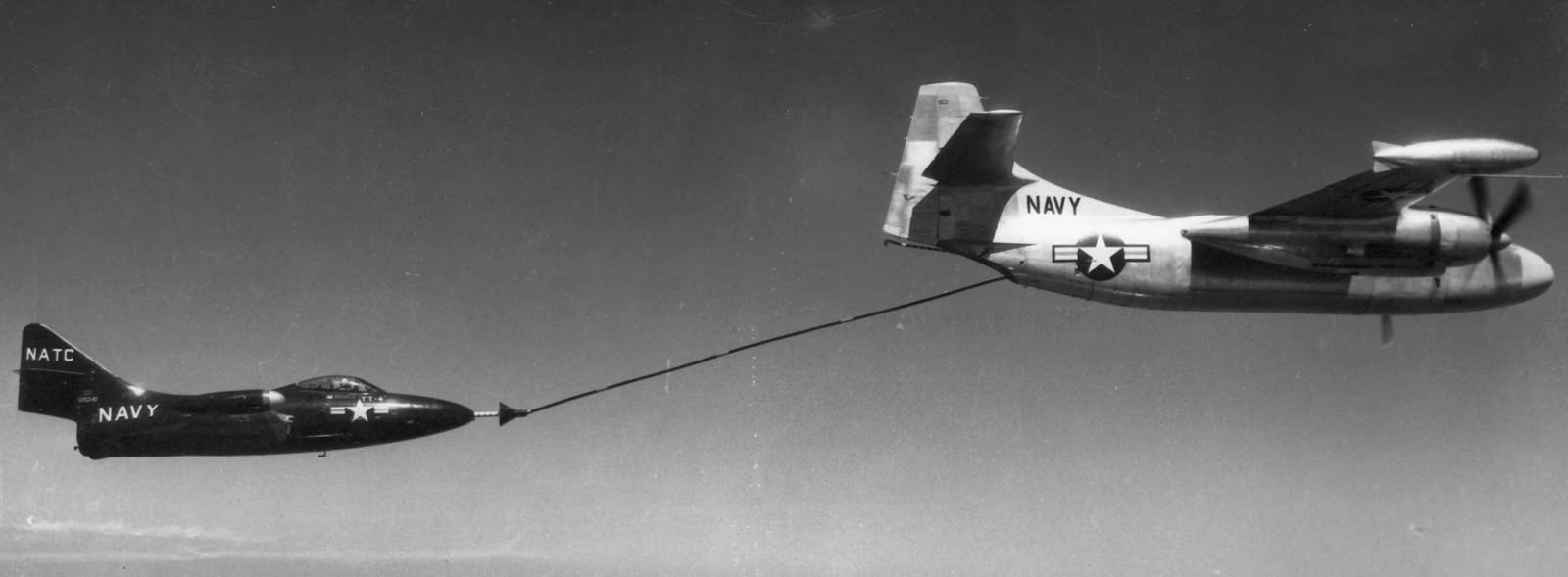
The original post didn't delve much into the Navy's development of inflight refueling of jets. One of the first inflight evaluations in late 1952 involved the North American AJ Savage, with an XAJ-1 being modified to replace the jet engine in the aft fuselage with a refueling reel, hose, and drogue.
North American apparently proposed an AJ-2 in this configuration but it would appear that the extra speed provided by the jet engine was worth the reduction of available volume for bombs in the bomb bay.
As a result of the successful evaluation of the concept and the desire to extend the range of the Banshees that were the first carrier-based jets to be armed with a tactical nuclear weapon, kits were developed to be installed in the bomb bays of AJ Savages and the F2H-2B and many F2H-3/4s were modified with refueling probes in 1953.
The original post didn't delve much into the Navy's development of inflight refueling of jets. One of the first inflight evaluations in late 1952 involved the North American AJ Savage, with an XAJ-1 being modified to replace the jet engine in the aft fuselage with a refueling reel, hose, and drogue.
North American apparently proposed an AJ-2 in this configuration but it would appear that the extra speed provided by the jet engine was worth the reduction of available volume for bombs in the bomb bay.
As a result of the successful evaluation of the concept and the desire to extend the range of the Banshees that were the first carrier-based jets to be armed with a tactical nuclear weapon, kits were developed to be installed in the bomb bays of AJ Savages and the F2H-2B and many F2H-3/4s were modified with refueling probes in 1953.
Note that the drogue was initially a rigid, all-metal cone.
This was soon replaced by the collapsible and presumably lighter shuttlecock-type drogue that was more stable in trail than the all-metal cone and less likely to ding the fuselage of either the tanker or the receiver.
As reported in the original Texaco post, Douglas developed the grandfather of what is now the standard externally mounted refueling store but there were alternatives. McDonnell evaluated a pod for the F3H that the Navy didn't buy. (I had assumed that it was developed by McAir but a caption in the 18 January 1957 issue of Flight identifies it as a Beechcraft Model 102-G refueling store.)
Vought also proposed one for the F7U/A2U program but it probably failed to even reach the hardware stage as a result of the Navy's loss of enthusiasm for the Cutlass. Only North American's design was deployed on the tanker buddy of its FJ-4B alternative to the A4D Skyhawk for nuclear weapon delivery. (Either the North American version was fielded as a backup up to the Douglas D-704 store, consistent with the Navy's belt and suspenders approach to aircraft development at the time, or the low-wing configuration of the FJ-4 precluded the use of the Douglas store.)
Note that the right external store contained the drogue. The matching left-hand store was also equipped with an air-driven pump to transfer its fuel to the right-hand store.
Attempts were made to increase the vertical separation between the tanker and the receiver with booms. The A3D was evaluated with one. It proved unsatisfactory.
External stores with this feature were also developed. This one being considered by the Air Force, here hung on an F-84F, was evaluated by NATC in 1958, only a year or so after the Douglas buddy pod was introduced in the fleet.
Beech also developed a similar pod beginning circa 1960, leasing a civil-register Douglas A-26 as the tanker. It was evaluated by the Navy in 1961, here with an A3J*.
NATC also hung the Beech pod under an F4H, presumably to evaluate it at higher speeds than achievable by the A-26, with the following picture prompting Kim's question.
None of these boom-type solutions proved to be superior overall to the simpler original concept of simply trailing the drogue out the back of a pylon-mounted pod that is still the standard today, almost 60 years after its introduction.
However, the Air Force did introduce a similar arrangement in order to provide drogue-refueling capability from its boom-equipped tankers. As originally implemented on the KC-135, it was referred to, not fondly, as the Iron Maiden. For an illustration and excellent firsthand description of refueling from it, I highly recommend that you read this: http://www.neptunuslex.com/2005/08/13/rhythms-part-xviii/
*The A3J-1 itself served briefly as a tanker, notably on its deployment on Independence.
The refueling store was located in the tunnel which existed to house the nuclear store and jettisonable fuel tanks.
This was soon replaced by the collapsible and presumably lighter shuttlecock-type drogue that was more stable in trail than the all-metal cone and less likely to ding the fuselage of either the tanker or the receiver.
As reported in the original Texaco post, Douglas developed the grandfather of what is now the standard externally mounted refueling store but there were alternatives. McDonnell evaluated a pod for the F3H that the Navy didn't buy. (I had assumed that it was developed by McAir but a caption in the 18 January 1957 issue of Flight identifies it as a Beechcraft Model 102-G refueling store.)
Vought also proposed one for the F7U/A2U program but it probably failed to even reach the hardware stage as a result of the Navy's loss of enthusiasm for the Cutlass. Only North American's design was deployed on the tanker buddy of its FJ-4B alternative to the A4D Skyhawk for nuclear weapon delivery. (Either the North American version was fielded as a backup up to the Douglas D-704 store, consistent with the Navy's belt and suspenders approach to aircraft development at the time, or the low-wing configuration of the FJ-4 precluded the use of the Douglas store.)
Note that the right external store contained the drogue. The matching left-hand store was also equipped with an air-driven pump to transfer its fuel to the right-hand store.
Attempts were made to increase the vertical separation between the tanker and the receiver with booms. The A3D was evaluated with one. It proved unsatisfactory.
External stores with this feature were also developed. This one being considered by the Air Force, here hung on an F-84F, was evaluated by NATC in 1958, only a year or so after the Douglas buddy pod was introduced in the fleet.
NATC also hung the Beech pod under an F4H, presumably to evaluate it at higher speeds than achievable by the A-26, with the following picture prompting Kim's question.
None of these boom-type solutions proved to be superior overall to the simpler original concept of simply trailing the drogue out the back of a pylon-mounted pod that is still the standard today, almost 60 years after its introduction.
However, the Air Force did introduce a similar arrangement in order to provide drogue-refueling capability from its boom-equipped tankers. As originally implemented on the KC-135, it was referred to, not fondly, as the Iron Maiden. For an illustration and excellent firsthand description of refueling from it, I highly recommend that you read this: http://www.neptunuslex.com/2005/08/13/rhythms-part-xviii/
*The A3J-1 itself served briefly as a tanker, notably on its deployment on Independence.
The refueling store was located in the tunnel which existed to house the nuclear store and jettisonable fuel tanks.
Subscribe to:
Posts (Atom)