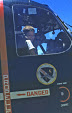
One of the blogs that I read every day, one of the few that I provide a link to, and the one I invariably enjoy the most is http://www.neptunuslex.com/ written by retired Navy Captain, Carroll LeFon, familiarly known as Lex. He had been among other things, the executive officer of TOPGUN, a fighter pilot's fighter pilot who could also write entertainingly and informatively. In the process of creating Strike from the Sea, I had emailed him with a question about dumb-bomb delivery since he had written an illustrated anecdote about the process. He responded promptly and was very helpful in correcting and improving my draft.
After retiring from the Navy, Lex had gotten a desk job but also flew light aircraft on weekends at one of those air-combat flight experience companies. However, it was clear that he missed flying jets. He recently left his cubicle and returned to the cockpit, going to work for ATAC, a company providing adversary fighter services to the U.S. military, among other things. See http://www.atacusa.com/.
He flew the Kfir, an Israeli modification of the Dassault Mirage powered by a J79. The Navy had leased several of these as F-21s to be used to provide dissimilar aircraft air-to-air combat training. These were subsequently turned back to Israel.
ATAC was operating the very similar Kfir C2s that had been retired by the Israeli Air Force. In the past few months in his blog, Lex took us through his experience with checking out in the idiosyncratic little beast and flying it as an adversary: self-effacing, lighthearted, and witty as usual. His joy in being back in the air in a single-seat jet fighter providing realistic training for the crews of Navy ships and tactical airplanes was readily apparent. But reading between the lines, I couldn't help but wonder if this would end badly.
Yesterday, 6 March, it did. He "stepped into the clearing at the end of the path", as he was wont to say about other departed friends and acquaintances, while landing at NAS Fallon, Nevada. He will be missed.
By Tommy H. Thomason
Wednesday, March 7, 2012
Friday, February 24, 2012
Liquid-Cooled Engine Redux
Paul Faltyn of the Niagara Aerospace Museum recently provided me with some Bell Aircraft artists concepts of a marinized P-39 Aerocobra.
They are in the colorful U.S. Navy pre-war markings that identified which carrier the airplanes were operating from, the squadron (in this case VF-5), and the individual aircraft's relative position in the squadron. Note that there is no national insignia on the fuselage. If you look closely, the main landing gear is aft of the main wing spar, indicating that unlike the carrier-capable P-39 subsequently proposed to the Navy, this airplane had a tricycle landing gear.
This is verified by the illustration of a takeoff from an aircraft carrier.
Even more interesting, and hinted at by the extension of the carburetor inlet fairing evident on close examination of the first illustration above, is what appears to be a turbo supercharger in the following cutaway drawing.
The P-39 was originally supposed to have a turbo supercharger for maximum performance at altitude. The XP-39 first flew with one. Following an analysis of flight and wind-tunnel test results, it was deleted. Bell proposed what became the Navy's FL-1 without it, along with a change to a conventional landing gear and other changes.
The Allison engine incorporated a single-stage, single-speed supercharger. This meant that power dropped off after 12,000 feet, significantly handicapping its speed and climb performance relative to fighters powered by engines with additional supercharging
It probably wouldn't have made any difference to the outcome of the Navy fighter competition in which the Bell FL-1 was entered, since the turbo-supercharger would have added weight and required an even more significant redesign to the basic P-39 than the changes that resulted in the FL-1. However, if the Bell engineers could have come up with a way to do it, then the FL-1 would have had performance at altitude superior to the Grumman F4F Wildcat and might possibly have been the successor to the disappointing Brewster F2A Buffalo instead of the Wildcat.
For what really happened with the Bell FL-1, see my monograph on the Airabonita published by Steve Ginter and also available from Amazon.
Wednesday, February 22, 2012
Navy Shooting Stars
The Navy obtained two Lockheed P-80As from the Army and assigned them BuNos 29667 and 29668. At least one, BuNo 29668, was modified with carrier-based hardware for catapult takeoffs and arrested landing.
In the shipboard trials aboard Franklin D. Roosevelt on 1 November 1946, Marion Carl made four deck runs (starting from virtually the fantail) and two catapult launches at fairly light gross weights and about 35 knots wind over deck. All were satisfactory. Landings were a bit trickier, requiring precise speed control and pitch attitude at touchdown.
I've written about the original use of 29668 in carrier trials in my modeling blog. See: http://tailspintopics.blogspot.com/2011/11/lockheed-p-80a-carrier-trials.html.
Lockheed reportedly referred to the Navy P-80s internally as FO-1s, which they assumed would be the Navy designation, F for fighter and O for Lockheed-Burbank. However, it reportedly had been used officially for a handful of photoreconnaissance P-38s that the Navy obtained from the Army Air Forces and operated in Europe during World War II.* The next Lockheed fighter would therefore have been the F2O. In any event, the Navy apparently didn't assign its designation to the aircraft, always referring to them as P-80As.
BuNo 29667 was reportedly stricken on 13 February 1947 and 29668, on 4 June 1947. Lockheed proposed carrier-capable P-80Bs to the Navy in 1947 as the FO-2, consistent with its referring internally to the Navy P-80As as FO-1. The Navy, however, declined the opportunity in favor of production of the jet fighters it had developed, the Grumman F9F Panther and the McDonnell F2H Banshee.
The Navy did procure a third P-80A (Army Air Forces serial number 44-85235, Navy BuNo 29689) and a P-80B (Army Air Forces serial number 45-8557, Navy BuNo 29690). These were assigned to the Navy’s missile test facility at Point Mugu, California as a chase and safety aircraft. In the event that a missile went astray, the P-80 pilot was to shoot it down with his machine guns. Both of these P-80s were eventually painted Navy gloss blue. (689 was originally pearl grey like the Army Air Forces' P-80s.) Since these were not operational airplanes, the Navy did not bother to assign them Navy designations and they were referred to officially as P-80s. For more on these two P-80s, see http://herschpahlbooks.com/dedications/cliff_weirick.htm
In early 1948, however, the Navy realized that they couldn't get jet fighters from Grumman and McDonnell fast enough to meet its near-term needs for both jet transition training and operational squadrons. (This shortfall might have been caused, at least in part, by schedule delays in the production of Vought F6Us) The solution was to buy 50 P-80Cs from the Air Force to “train pilots and maintenance personnel in operation of jets.” These were stock 50 P-80s (49 P-80C-1-LO and 1 P-80C-5-LO), designated TO-1s since the Navy considered them to be trainers and they were not carrier capable. They were assigned BuNos 33821-33870. “To simplify problems of maintenance and logistic support”, all were initially based in the San Diego area. Of the 50, 36 were assigned to two squadrons and the rest were held in reserve for attrition.
VMF-311 received 12 and operated them from MCAS El Toro, California.
VF-6A, to be redesignated VF-52, initially received 24. A handful of VF-52 pilots completed Air Force jet transition training in the P-80 at Williams Field, Arizona and returned to instruct the remainder of the squadron pilots; the squadron then functioned as the Navy's jet transition training unit.
The Navy also procured the two-seat trainer version of the P-80, the T-33, as the TO-2.
The Navy subsequently decided to transfer responsibility for jet transition training to the training command. VF-52 received Grumman F9F-3 Panthers and prepared to deploy. Advanced Training Unit SIX (ATU-6) at NAS Corpus Christi received its first TO-1 in July 1949. Two months later, the unit transferred to NAS Whiting Field, Milton, Florida, and was redesignated Jet Transitional Training Unit ONE (JTTU-1). The squadron's mission was extended to include training of fleet pilots. (The unit transitioned the U.S. Navy's Flight Demonstration Squadron, the Blue Angels, to jet aircraft.) On 20 August 1951, JTTU-1 moved to NAS Kingsville, Texas and was redesignated Advanced Training Unit THREE (ATU-3).
In 1952, the TO-1 became the TV-1 and the TO-2, the TV-2 when the Navy finally decided to recognize that Lockheed’s two manufacturing divisions belonged to a single company.
Late in 1952, ATU-3 became ATU-200. The squadron's mission consisted of training newly designated aviators in familiarization, formation tactics, instruments and navigation using both TV-1s and 2s.
Surviving TV-1s were transferred to the reserves after sufficient numbers of obsolescent Grumman F9F Panthers became available for assignment to training squadrons.
*That may be, but if the Navy did assign FO to those P-38s, it had forgotten about it by 1951, because it was then assigned to Lockheed's vertical-rising convoy fighter, better known as the XFV-1 after the Lockheed O's were changed to V's...
Tuesday, January 31, 2012
Carrier-Based Airplanes Weigh More
Carrier landings are one reason. Not only is the airplane carrying a tailhook attached with structure to allow it to pull on the airplane with two to three times its landing weight, a nose gear that can pull the whole airplane down the catapult track, a wing folding arrangement, extra wing area, etc, the landing gear has to withstand twice the sink rate of a land-based airplane and not always symmetrically or straight ahead.
The touchdown shown above puts quite a bit of side load on the landing gear. In order to minimize the weight of a landing gear that could withstand it, the engineers who designed the F-14 incorporated a unique load link between the main landing gear strut and the fuselage that was established after the gear was extended.
Why the Rube Goldberg (Heath Robinson to the Brits) arrangement, you might well ask? That's illustrated by a comparison of the Grumman A-6 and F-14 main landing gear struts. They are very similar in overall length, diameter, and attachment to the fuselage even though the F-14 landing weight was 50% greater. If anything, the F-14's side brace at the top of the strut looks less sturdy (i.e. heavy) than that of the A-6.
As often happens with innovative designs, there was an unintended consequence that wasn't apparent in development, qualification, or service test or even in initial operational use. Presumably engineering took into account the splaying loads generated on touchdown that are at least partially mitigated by the lateral friction of the tire against the landing surface. They doubtless took into account that some landings would occur where the tire's resistance to sliding sideways was minimal, such as a touchdown zone coated with rubber deposits and wet from rain.
They might have been aware of the anti-skid coating applied to metal aircraft carrier decks that would have been even more resistant to splaying than a concrete runway.. But what they apparently didn't know, according to Craig Kaston, was that the coating wore down during a six-month deployment and was not necessarily renewed, particularly in the landing area. The result was much more frequent and severe instances of side loads being reacted by the fuselage fitting, with damage eventually becoming apparent in the bulkhead located at fuselage station 569 to which it was attached.
Monday, January 16, 2012
What was the Bell Aircraft F2L?
This is another one of those works-in-progress, since I don't have everything nailed down yet. However, I have enough bits and pieces to start with.
The first Bell Aircraft Navy fighter was, of course, the XFL-1. I've written a monograph on it for Steve Ginter's Naval Fighters series. It's pretty comprehensive if I do say so myself and addresses some common misconceptions about the Airabonita. It's available from Amazon and others.
Some have written that the P-59A was the F2L (more on that in a minute). The Navy History Center lists two F2Ls with BuNos, the XF2L (90060 and 90061) and the F2L-1K (91102 and 91103). The XF2L is stated to be canceled P-63s*, which sort of makes sense because those Bureau Numbers were used to contract for the L-39s, swept-wing configured P-63s. (For more on the L-39s, see http://thanlont.blogspot.com/2011/04/bell-l-39-wing-sweep-evaluation.html)
The F2L-1Ks were postwar modifications of Army P-39Qs as drones. These were flown at NAS Cape May, New Jersey. I don't have any pictures yet. A Navy History Center list includes the crash of an F2L in 1946. It turns out that there were two crashes, both F2L-1Ks being flown from the cockpit. BuNo 91102 had an engine failure in the pattern at Cape May and was dead-sticked to a wheels up landing. While operating from NAAS Chincoteague, VA, BuNo 91103 apparently had a brake lock and rudder jam after the disconnect in flight of the remote control system and went off the runway during the landing. Both airplanes were strikes.
These F2L-1Ks may have been preceded by an XTDL-1 (another P-39 modification) that wasn't given a Bureau Number, which would be rare but not unknown or they may have originally designated or intended to be designated TDL, which makes more sense than F2L, since the airplanes were to be used operationally as target drones, not fighters. Although some references list as many as seven were created, it appears more likely that only two P-39s were converted and the remainder cancelled.
Back to the P-59A. In 1941, when the Army asked Bell to design and develop its first jet airplane, Bell had a contract with the Army for the XP-59. It was to be powered by a P&W R-2800 driving a contrarotating pusher propeller. It had reached the mockup stage and was also being proposed to the Navy.
Note the inlet in the nose for cooling air to the R-2800 and the cannon or machine gun barrels at the front of the tail booms. The stand reads Proposed Navy VF Fighter Spec. SD 112.18. F2L does not appear, although of course this would have been its designation if the Navy had contracted for it.
Some of the mockup pictures include the words "Proposed Navy Fighter" and in others, like this one, Navy Fighter has been carefully erased.
Lest one think that it was pictures of the mockup of the Army airplane with captions added for the Navy's benefit, a picture of the mockup's cockpit shows the presence of a chart board, which was a Navy requirement.
When the Army contracted with Bell for a jet airplane in December 1941, it did so with the designation XP-59A, presumably using the same contract as the now unwanted XP-59. It was, of course, a completely different configuration. The objective was to add a layer of secrecy to the program.
The Navy obtained two YP-59As and three P-59Bs for its evaluation and pilot familiarization. This is the first Navy YP-59A, as received in late 1943.
It was given BuNo 63960. It was subsequently repainted in the Navy tri-color paint scheme. Note that it does not have guns.
At some point after that, it was brought up to production P-59 standard (square wing tips, ventral fin, etc.) and repainted again, this time with yellow wings for some reason.
Note, however, that the designation marked on it is "YP59-A".
One theory behind a Navy designation of YF2L for its YP-59A is the existence of the F2L-1Ks to provide misdirection. This almost certainly wasn't the case given that the Navy's drone P-39 program was later in time. Somewhat more plausible is that the YF2L designation was a subterfuge equivalent to the Army's use of the P-59A designation since the XP-59 had been proposed to the Navy. If so, the Navy doesn't appear to have used it in any documents found to date. Its P-59s are always referred to as P-59s.
The Navy also kept pretty good track of assigned designations so it seems likely that the post-war contract for P-39 drones would have used the designation F3L if F2L had been used in the early 1940s for the Airacomet, unless the designation was not a subterfuge but the program considered so secret that the designation was never revealed...
*Bell reportedly proposed a carrier-based P-63. It's conceivable that these Bureau Numbers, originally assigned to an RY-3 Privateer contract, might have been intended for that evaluation before they were used for the L-39s. However, they seem to be too high for that possibility.
The first Bell Aircraft Navy fighter was, of course, the XFL-1. I've written a monograph on it for Steve Ginter's Naval Fighters series. It's pretty comprehensive if I do say so myself and addresses some common misconceptions about the Airabonita. It's available from Amazon and others.
Some have written that the P-59A was the F2L (more on that in a minute). The Navy History Center lists two F2Ls with BuNos, the XF2L (90060 and 90061) and the F2L-1K (91102 and 91103). The XF2L is stated to be canceled P-63s*, which sort of makes sense because those Bureau Numbers were used to contract for the L-39s, swept-wing configured P-63s. (For more on the L-39s, see http://thanlont.blogspot.com/2011/04/bell-l-39-wing-sweep-evaluation.html)
The F2L-1Ks were postwar modifications of Army P-39Qs as drones. These were flown at NAS Cape May, New Jersey. I don't have any pictures yet. A Navy History Center list includes the crash of an F2L in 1946. It turns out that there were two crashes, both F2L-1Ks being flown from the cockpit. BuNo 91102 had an engine failure in the pattern at Cape May and was dead-sticked to a wheels up landing. While operating from NAAS Chincoteague, VA, BuNo 91103 apparently had a brake lock and rudder jam after the disconnect in flight of the remote control system and went off the runway during the landing. Both airplanes were strikes.
These F2L-1Ks may have been preceded by an XTDL-1 (another P-39 modification) that wasn't given a Bureau Number, which would be rare but not unknown or they may have originally designated or intended to be designated TDL, which makes more sense than F2L, since the airplanes were to be used operationally as target drones, not fighters. Although some references list as many as seven were created, it appears more likely that only two P-39s were converted and the remainder cancelled.
Back to the P-59A. In 1941, when the Army asked Bell to design and develop its first jet airplane, Bell had a contract with the Army for the XP-59. It was to be powered by a P&W R-2800 driving a contrarotating pusher propeller. It had reached the mockup stage and was also being proposed to the Navy.
Photo provided by Niagara Aerospace Museum
Note the inlet in the nose for cooling air to the R-2800 and the cannon or machine gun barrels at the front of the tail booms. The stand reads Proposed Navy VF Fighter Spec. SD 112.18. F2L does not appear, although of course this would have been its designation if the Navy had contracted for it.
Some of the mockup pictures include the words "Proposed Navy Fighter" and in others, like this one, Navy Fighter has been carefully erased.
Photo provided by Niagara Aerospace Museum
Lest one think that it was pictures of the mockup of the Army airplane with captions added for the Navy's benefit, a picture of the mockup's cockpit shows the presence of a chart board, which was a Navy requirement.
When the Army contracted with Bell for a jet airplane in December 1941, it did so with the designation XP-59A, presumably using the same contract as the now unwanted XP-59. It was, of course, a completely different configuration. The objective was to add a layer of secrecy to the program.
The Navy obtained two YP-59As and three P-59Bs for its evaluation and pilot familiarization. This is the first Navy YP-59A, as received in late 1943.
It was given BuNo 63960. It was subsequently repainted in the Navy tri-color paint scheme. Note that it does not have guns.
At some point after that, it was brought up to production P-59 standard (square wing tips, ventral fin, etc.) and repainted again, this time with yellow wings for some reason.
Tom Doll collection via Rich Dann
Note, however, that the designation marked on it is "YP59-A".
One theory behind a Navy designation of YF2L for its YP-59A is the existence of the F2L-1Ks to provide misdirection. This almost certainly wasn't the case given that the Navy's drone P-39 program was later in time. Somewhat more plausible is that the YF2L designation was a subterfuge equivalent to the Army's use of the P-59A designation since the XP-59 had been proposed to the Navy. If so, the Navy doesn't appear to have used it in any documents found to date. Its P-59s are always referred to as P-59s.
The Navy also kept pretty good track of assigned designations so it seems likely that the post-war contract for P-39 drones would have used the designation F3L if F2L had been used in the early 1940s for the Airacomet, unless the designation was not a subterfuge but the program considered so secret that the designation was never revealed...
*Bell reportedly proposed a carrier-based P-63. It's conceivable that these Bureau Numbers, originally assigned to an RY-3 Privateer contract, might have been intended for that evaluation before they were used for the L-39s. However, they seem to be too high for that possibility.
Saturday, January 7, 2012
Portable Air-Start Cart
In the early days of jet airplanes, there weren't very many air-start carts at civil airports or some military fields either. This wasn't a problem when jet engines were started with electric motors like piston engines. However, electric starters were heavy so they were replaced on many jet engines in the late 1940s by a small turbine that required high pressure/volume air that spun the engine up to start rpm. This meant landing at an airport without an air-start cart meant being stranded until one could be located and made available.
The Navy's solution was a start unit that could be carried as a store shaped like a World War II external fuel tank, shown here on an early production Douglas F4D Skyray:
It incorporated a amall AiResearch jet engine, designed as an APU (Auxiliary Power Unit), to provide the air. Panels were opened or removed to expose the APU inlet and exhaust, the attachment of the air hose, and the control panel.
Also stowed within the cart were the hose, wheels, and a handle to pull it along like child's wagon.
The handle also steered the front wheel and when raised vertically, braked it. One source of entertainment for the ramp rats was to start the APU up, staddle it like a horse, and push the handle forward. The thrust of the APU would start it rolling. This practice was, of course, prohibited.
The pod was often present at airshows at civil airports, carried there and back on a standard external stores pylon.
It remained useful to the Blue Angels up through the retirement of their A-4s powered by the J52 with an impingement starter:
The Navy's solution was a start unit that could be carried as a store shaped like a World War II external fuel tank, shown here on an early production Douglas F4D Skyray:
It incorporated a amall AiResearch jet engine, designed as an APU (Auxiliary Power Unit), to provide the air. Panels were opened or removed to expose the APU inlet and exhaust, the attachment of the air hose, and the control panel.
Also stowed within the cart were the hose, wheels, and a handle to pull it along like child's wagon.
The pod was often present at airshows at civil airports, carried there and back on a standard external stores pylon.
It remained useful to the Blue Angels up through the retirement of their A-4s powered by the J52 with an impingement starter:
Sunday, January 1, 2012
Project Steam
The superiority of airplanes powered by jet engines was bad news for the carrier navy. Jets required a lot of fuel, which meant bigger and heavier airplanes, and didn't provide much thrust at low speeds. Both dictated the need for a more powerful catapult. Unfortunately, the hydraulic catapult was pretty much at the top end of its capability. The U.S. Navy had evaluated a German design for a hydrogen peroxide powered catapult (it was used to launch the V-1 pulse-jet surface-to-surface missile) using both hydrogen peroxide and steam but dropped it in favor of developing one that used gun powder. An explosive charge had been used to launch seaplanes from cruisers and battleships since 1925 and was projected to be the simpler and require less space and weight.
Just in time, Colin Mitchell perfected the steam catapult. See http://thanlont.blogspot.com/2011/03/steam-catapult-development.html. After a demonstration, the Navy immediately bought five, one for test at the Philadelphia Navy Yard, and two each for Hancock and Ticonderoga. Hancock was completed first, recommissioned on 15 February 1954, and so it was that only a few months later, in June, she sailed out into the Pacific waters off San Diego in support of Project Steam, an at-sea evaluation of its new catapults.
There was no question that the steam catapult was superior in throw weight. The question was the compatibility of jet engines with the steam catapult among other operational issues. So the Navy gathered up samples of the newest versions of carrier-capable aircraft they had and launched them from Hancock, including sending a couple of F7U-3s cross country from Patuxent River.
Propeller-driven airplanes were included in addition to the jets. An NATC Flight Test S2F (note that the catapult pendant has been tied on so as to minimize the number required and shorten the time to hook up for the next launch):
And just recently, duh, I discovered that AJ Savages were also part of the trials, albeit later in the year (this picture was dated 28 September 1954):
The trials were extremely successful. One of the significant attributes of the steam catapult was that it provided acceleration for most of its stroke and there was little snatch load at the beginning of the stoke, making for a much more comfortable launch. This was particularly appreciated at night.
Just in time, Colin Mitchell perfected the steam catapult. See http://thanlont.blogspot.com/2011/03/steam-catapult-development.html. After a demonstration, the Navy immediately bought five, one for test at the Philadelphia Navy Yard, and two each for Hancock and Ticonderoga. Hancock was completed first, recommissioned on 15 February 1954, and so it was that only a few months later, in June, she sailed out into the Pacific waters off San Diego in support of Project Steam, an at-sea evaluation of its new catapults.
There was no question that the steam catapult was superior in throw weight. The question was the compatibility of jet engines with the steam catapult among other operational issues. So the Navy gathered up samples of the newest versions of carrier-capable aircraft they had and launched them from Hancock, including sending a couple of F7U-3s cross country from Patuxent River.
(Photo by Maurice Duke)
Many of the test subjects, however, were from West coast squadrons, flown by fleet pilots, not NATC pilots. Although FJ-2s were assigned to the Marines and almost never deployed on aircraft carriers, this VMF-235 Fury could be considered a stand-in for the FJ-3, which was to be assigned to Navy fighter squadrons:
(Photo by Maurice Duke)
The F9F-6 was evaluated as well.
Similarly, although F3Ds only rarely deployed on aircraft carriers, this VX-4 F3D-2M carrying four Sparrow I missiles made for a relatively heavy test subject:
(Photo by Maurice Duke)
Other aircraft launched included the AD-5 and F2H-3/4.And just recently, duh, I discovered that AJ Savages were also part of the trials, albeit later in the year (this picture was dated 28 September 1954):
The trials were extremely successful. One of the significant attributes of the steam catapult was that it provided acceleration for most of its stroke and there was little snatch load at the beginning of the stoke, making for a much more comfortable launch. This was particularly appreciated at night.
Subscribe to:
Posts (Atom)